In the End, It’s Up to Us

This isn’t a political post. It might seem like one. But that depends on the eyes and the lens with which you choose to read it. This is a post about humanity. About citizenship. About our rights and responsibilities in this great nation. This is a post from one human to another, hoping to appeal to all of us, regardless of where we fall on the political spectrum. Regardless of who we did or did not vote for. Regardless of our biases, our fears, our worries, or our convictions.

This is a post that asks you, as a person, to stop, reflect, and consider what comes next. Because what comes next is what will define us—and you—as individuals and as a nation. This election didn’t determine the fate of our country. We determine that. We have that power. That is what democracy and a Constitutional Republic are founded upon. It is up to us to decide what comes next and how we choose to behave in the coming months, years, decades.

Do not forget: this country was founded on the premise that the government works for us. We’ve had a tumultuous few years, and we are coming off an election that was pivotal, poignant, and a turning point. But regardless of what you won or lost, who you voted for or didn’t, the work doesn’t end on election day. The work is just beginning.

You want a better America? We all do, even if we don’t agree on what that looks like. But divisive vitriol and hatred won’t get us there. Now, more than ever, we need to put derision and hatred aside and come together. When you make a decision, ask yourself: Am I only thinking of myself, or am I considering my neighbor, my friend, my family, my butcher… in other words, am I thinking of the greater good?

Democracy and our government were based on the greater good, on limited government and the protection of minority rights. Our country was born from the desire for freedom from persecution and a lack of voice. It was founded on the belief that all men (and women) are created equal, with inalienable rights. We were once a proud nation of Enlightenment philosophy and high expectations. We held people accountable and loved our neighbors.

So, before you act, before you do anything else, take a moment. Reflect. Imagine the country you want to live in and be proud of. Imagine your neighbor, your friend, or the stranger you pass on the street. What makes a nation great? What makes us strong? Seriously consider how you can have an impact and choose to work for good. Make decisions out of hope and promise, not fear and despair. This nation isn’t defined by one person. Each of you has a place and a voice. Use it wisely.

We are all on this ride together, divided or not, and the destination is in our hands. Choose love over hate, compassion and empathy over anger and belittlement, action over passive aggression. Be a willing, noble participant in democracy. Don’t give up. Don’t walk away. Don’t lower your gaze.

Do not be afraid of what you don’t understand. Fear only leads to hate and breeds contempt. If something frightens you, face it—ask questions, seek understanding, learn. It is not for us to be judge, jury, and executioner. There are other worlds than this, and greater powers at work. Our role is to make good on the time we are given, to abide by the principles that guide us: love, honor, and value. The rest will sort itself out, if you believe in that. And if you don’t, there’s still the golden rule we all share: “Do unto others as you would have them do unto you.”

There is no God, no higher power, and no man who can or will excuse or condone hatred. The teachings of Jesus, of other prophets and religious figures, of parents, heroes, or guides in our lives have been clear: there is no justification for violence against another. We do not condone hate. We do not condone violence. Whatever our belief system or upbringing, each of us has been taught love at some point.

We are given free will to choose our path, and eventually, we will all be judged by what is in our hearts—whether by a higher power we believe in, or by the legacies we leave behind. With this free will, each of us must decide how we will act, how we will treat others, and what kind of world we wish to create.

Ultimately, it’s not about the beliefs we hold, but the way we live them out. Choose to be a force for good. Choose to rise above fear and meet the unknown with curiosity and courage. Because in the end, our actions define not just who we are, but the world we leave behind.

One hand on the starboard rail

It was 1985 (or so) and I was 8 (or so) riding with my Bam to somewhere in her brown Caprice Classic. She was smoking a Capri, one of those weird long and ultra-skinny cigarettes. I liked watching her smoke. I know now I shouldn’t have. But the way her thin hands embraced it and her perfect nails complimented it. It just looked ladylike. Feminine. And beautiful. She pushed a cassette into the tape deck and looked at me and said as the tape clicked into place “don’t tell your mother I let you listen to this”. The song was Pencil Thin Mustache. I watched her sing along, tapping the cigaretted hand and nails, keeping in time on the steering wheel. The tendrils of smoke escaping as she mouthed “the Boston Blackie kind”. I didn’t know what I listening to or who Boston Blackie was. I didn’t really understand the song but then He Went to Paris came on and I realized I was sharing a special moment with my Bam. That was my first encounter with Jimmy Buffett.

It was 1992 (or so) and I was 15 (or so) and Makenzie gave me a copy of Fruitcakes. We listened to it on repeat, driving around in her white Toyota truck that she taught me to drive a stick shift in. I went to my first Buffett show with her. We wore coconut bras and made sure our fins to the left and fins to the right were on point. That same year (or so) my mum gave me a copy of the book Where is Joe Merchant as my birthday book. I read it overnight and was consumed by the adventures of Frank Bama. I fell in love with the Caribbean despite having never been there, decided I wanted to become a pilot of either a Grumman Goose or a P-51 Mustang, and knew I would one day travel the world. Buffett once said, “I sell escapism”, and I bought it, hook, line, and sinker.

It was 1997 (or so) and I was 19 (or so) and I was in college, working at a bar called the Loomis. My boss, Ed, was a huge Parrot Head, and every year he organized massive expeditions to Star Lake to see Jimmy in concert. When I say massive, I mean MASSIVE. He rented an RV, brought a generator to run the blender, and wore a grass skirt. The man was all in. We’d spend weeks leading up to it listening to Buffett, planning our trip and what drinks and other items we’d have. We lost Ed a few years ago and though I only went once, it was an experience I will never forget that keeps me connected to him and the light he shared with the world.

It was 2003 (or so) and I was 26 (or so) and I had decided to get married. It’s not something I dwell on or discuss much these days, but despite it being a moment of regret and failure, it is also a moment of unprecedented joy and familial love that I will always remember. I danced my father/daughter dance to Little Miss Magic. To this day when I hear that song I remember the feeling of being a fairy tale princess, beautiful and timeless in my father’s arms. It is that moment and that song that I remember, that helps ease the pain of my embarrassing foray into matrimony. It is a moment, regardless of the outcome, that I treasure and love and come back to every time I hear that song.

I didn’t know Jimmy Buffett; I never met him, shook his hand, spoke to him, or had dinner with him. What I loved about him was personal because of what his words and his music and his ideology meant to me at pivotal moments in my life. I feel this loss deeper than most celebrities because in moments of great happiness, he was there in some way or fashion. Losing Jimmy Buffett meant the end of an era to me. A goodbye to a man and a legend that for 45 years of living played a role in my own thoughts and desires and dreams. I have a particular harbor I hope to retire to and plan to have oysters and beer for dinner soon. I carry my tattered copy of Joe Merchant with me on long trips. And as I grow older, I appreciate a Pirate’s view on 40 more and more each day, I know that my wrinkles represent the places my smile has been, and that I just want to live happily ever after, every now and then.

To my mum, on her 75th birthday

I was a child, wild and free.
I spoke out of turn,
and fed berries to my neighbor as dessert.
I feigned indifference
when poison control was called.
My siblings, who followed me
dined on dog biscuits and wet cat food.
I demanded attention
and learned to be valuable.
I am my mother’s daughter.

I was a child, wild and free.
I sought out danger,
and my own great beyond.
I broke my arm as a thief
pretending to fall of my bike
stealing chalky limestone
to write graffiti on the street.
I required adventure
and questioned everything.
I am my mother’s daughter.

I was a girl, wild and free.
I was captivated by puffins and myths,
and read our encyclopedias from A to P,
I imagined for myself
the world from Q to Z,
never feeling cheated of that knowledge.
Asking questions without answers,
I looked to the stars for guidance,
and learned their names and storied pasts.
I am my mother’s daughter.

I was a girl, wild and free.
I played the sports they loved
and made it into a career.
I got called names and mocked,
came home and cried
over losses I thought I had caused,
the serves I should have made.
I expected perfection
and refused no as an answer.
I am my mother’s daughter.

I am a woman, wild and free.
I challenge myself,
and fail fast and recover.
I always land on my feet.
Apologizing for faults like honesty and generosity,
for a face that hides nothing,
telling the truth I don’t want you to know.
I keep money in my car for anyone who needs it,
and I never ask why.
I am my mother’s daughter.

I am a woman, wild and free.
I value the world
and believe in justice.
We marched in Raleigh and DC,
for rights we shouldn’t have to ask for,
two generations joined in a constant battle.
Embracing and acknowledging history,
I listen the stories of others.
and stand my ground to fight for change.
I am my mother’s daughter.

I am my mother, wild and free.
I am compelled by equality,
and protect the safety of others.
I was raised to be fearless and proud,
encouraged to speak my mind,
the ugly truths of this world,
undeterred from what I know is right.
I replace hate with love,
and always strive to be more.
I am my mother’s daughter.

I am my mother, wild and free.
I will never stop learning,
and went back to school at 44.
I will earn my doctorate in education,
to bring closure to a dream
sacrificed long ago at the alter of motherhood.
Honoring a lifetime of legacy,
I smile at being called “chip”,
and know there is nothing more I need to be.
I am Sandy’s daughter.

Steady Ground

Growing old means growing up.
It is moving away and falling apart
and hoping you’ll land on steady ground.
It is an admittance to time and space
of values and ideas you formed,
but cannot claim as your own.
It is lessons learned,
wisdom you recall,
now a part of who you are and what you’ve become.
It is putting on a seatbelt
just to back out of the driveway
to move your car.
It is a road trip,
a long adventure to somewhere obscure
guided by look at that.
It is a feeling of calm,
finding a solution to a problem
that really isn’t the end of your world.
It is a slow and steady swing,
keeping your eye on the ball
to build focus and confidence and character.
It is gentle turns and casts,
easing lines and ropes
toward a dock or still and shaded pool.
It is a carefully crafted story teasing
the possibility of your imagination
that keeps your closet door closed.
It is the laughter,
private and silly and strange
at jokes only you understand.
It is a peanut in a book,
a monkey at a fair,
a tunnel filled with mystery,
the hilarity of window lock,
and knowing looks in unspoken exchanges.
It is a quiet voice,
a reminder of a lifetime of knowledge,
cherished and unshakeable.
It is unconditional and forgiving,
running deep into roots untouched,
protected from a world you’ve moved onto.
It is returning to a place and time
you never really left,
but maybe took for granted.
It is the embrace that greets you,
that welcomes you in
and reminds you that you’re ok.
It is the home you know,
the person you can always come back to,
the steady ground you’ve been seeking.

For Jamie…

There are stories that come into our lives and find their way into our souls. They are the tales we revisit time and time again. They are the stories we think about randomly, on idle afternoons, that bring a smile to our face and remind us of a time when things were simpler, life was slower, and possibility reigned free. Perhaps they remind of us being younger, or perhaps they quell our fears of growing old. Whatever purpose they serve, they come to us when we most need them and embrace us warmly like an old friend.

Like great stories, there are people who enter your life and become a part of who you are. They are the friends that share your secrets and always laugh at your jokes. They make you better because of who they are and what they mean to you. Their passion is contagious and ignites something new and wondrous in you. They make you better, and they leave a void when they go. And unlike a great book, you can’t put them on a shelf for safe keeping or store them away because someday, selfishly, you might need them. So, you try to slow time, you refuse to read the last few pages in a futile attempt to keep the story going, just a little longer. In each cherished memory you find hope and understanding. You know the story isn’t over and what is still to come holds all the possibility of the day you first met them. And you know, that one day, when the time is right, they will be there. You will pull them off the shelf, dust the cobwebs off the jacket that time dare not erase, and they will be there.

Why NOT Harriet Tubman?

The latest social media rant seems to be centered around the federal government’s decision to remove Andrew Jackson from the twenty dollar bill and replace him with Harriet Tubman. I read something on Facebook the other night where someone queried, “out of all the great black people that made a difference does any one know why they chose her? Just wondering.” Screen Shot 2016-04-21 at 10.19.13 PMIt was an honest question, I don’t think he was being a jerk about it or anything. It just got me thinking… And that got me trolling…And that got me writing…(I’m worried this is going to become a habit).

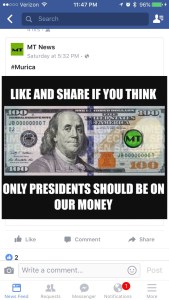
As I searched sites like Twitter, Instagram, Facebook, and Breitbart News (that is a horrid and terrifying place), I noticed three common themes emerging among the dissenters, 1) IMG_7740Harriet Tubman is ugly, 2) This is just one more plan by President Obama to ruin our nation (I think the term Obamanize was actually used), and 3) Most of the people complaining don’t have the faintest clue what it is they’re actually complaining about. Take the meme on the left. I seriously cried laughing. Now, the original poster, MT News, meant this as a knock against the current social media outcry over the Tubman decision. BUT, as it has been passed about the webs it has become a representation of hatred as more and more people share it because they believe the sentiment behind the wording, rather than understand the irony behind the image.

I’ve been trying to understand this situation and in order for me to do that, I need to break down each of the themes individually and view them through personal, historical, and social media lenses.

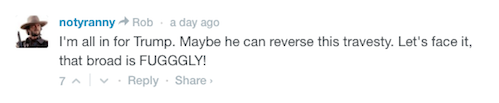
1) “Let’s face it, that broad is FUGGGLY!”

Screen Shot 2016-04-26 at 8.49.10 PM.png
From Breitbart News (Scary, scary place)

Screen Shot 2016-04-26 at 9.07.30 PM.png
Another Breitbart gem, at least guy doesn’t have an issue showing the world his racist side.

Screen Shot 2016-04-26 at 4.14.44 PM.pngScreen Shot 2016-04-26 at 4.15.13 PM.png

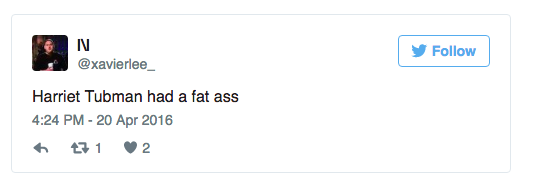
These are some of the many random comments and tweets I took screen shots of regarding the strange fascination Americans seem to have with how ugly Harriet Tubman is. I’ve lost count of the amount of times people commented on her “fat ass”, ugly face, and bad hair. The comments range from mildly annoying to downright racist. I personally don’t see the purpose of this logic. I mean, I agree, she’s not a looker, but neither am I. Hell, neither is most of the American population. Furthermore, what do looks have to do with her accomplishments or worthiness of being the face of the new twenty dollar bill? I could see this being a tad more logical if say, Ben Franklin or Abraham Lincoln were even remotely good looking, but let’s face it, our Founding Fathers and former presidents don’t often have that going for them as a trait. I have to believe deep down that America can’t be THAT superficial which means I AM choosing to believe that America IS that racist. I firmly believe these tirades are driven by ignorance, by the fact that deep down these people are pissed that a black woman is replacing a white man and while some show it more willingly than others, they have to look for seemingly less offensive ways to complain about the new face of the twenty.

Screen Shot 2016-04-21 at 10.03.55 PM
One of the best responses regarding the argument that Tubman is too ugly to be on US currency

2) “Obama’s Last Stab”

Screen Shot 2016-04-26 at 9.07.15 PM.png
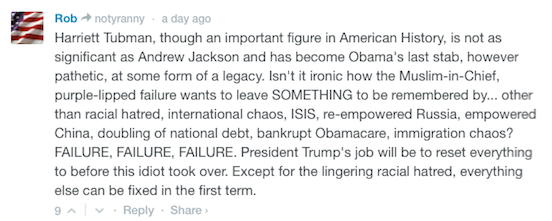
Breitbart News again, this guy doesn’t seem to hate Tubman as much as he does Obama, but it’s hard for me to not read “racist” into this comment.

Screen Shot 2016-04-26 at 9.10.48 PM.png
This guy believes this is the direction America is headed because we’re putting a black woman on the 20 dollar bill.
Somehow people in America have decided that this move toward equality in our currency is actually an evil and secret plot by the President to…to…to do what exactly? I’m going to guess it has something to do with the belief that President Obama is planning to take power from the “good, God-fearing, white Christians” of this “great” nation. The problem with this sentiment, aside from the obvious racism again, is that it’s just not true. People have been lobbying for years to get women, black people, Native Americans, and other minorities on US currency. Hell, in my research I found several failed attempts by House Representatives to get Ronald Reagan on the 10, 20, and/or 50 dollar bill. I have to wonder, if that was who was replacing Andrew Jackson would we be having this conversation? Also, as an interesting side note, people have been lobbying for years to have Andrew Jackson removed from US currency, school names, postage stamps, etc. In other words…NONE of THIS is a new idea folks. Furthermore, NONE of THIS is even something the President of United States has the power to control.

According to US law it is usually the Secretary of the Treasury (yes, I know, he WAS appointed by President Obama, but he was also APPROVED 71-26 by the US Senate…which means…that’s right…Republicans said yes too…) who determines which people and which of their portraits appear on US currency. However, legislation passed by Congress can also determine currency design. That doesn’t mean the President can’t make requests or suggestions regarding the matter, but it does mean HE CANNOT put Tubman on the twenty, regardless of whether he wants her there or not.

This most recent push for changing our currency had great help from a grassroots movement called “Women on 20s“, who gathered support for their cause and then petitioned President Obama to “instruct” Jacob Lew to put a woman on the twenty dollar bill. After a year of work, and the collection of hundreds of potential names for this honor, Jacob Lew, the Secretary of the Treasury, made the decision to honor the women’s suffrage movement on the 5, 10, and 20 dollar bills. Lew wrote a letter to the American people detailing his decision. By 2020 the plan is to have added women, white and black alike to the 5, 10, and 20 dollar bills. (By the by, 2020 marks the one hundred year anniversary of the 19th Amendment, which gave women the right vote).

3) We the People need a history lesson…

So now we’ve sort of come full circle, returning to the question that started me on this path, “why Harriet Tubman?” In my infinite wisdom, I decided that in order to understand “Why Harriet Tubman”, I had to first understand why any of them, so I started my research with the question, “why the presidents on the money?” I was curious. I learned a lot, including this, which actually surprised me.

Treasury Department records do not reveal the reason that portraits of these particular statesmen were chosen in preference to those of other persons of equal importance and prominence. By law, only the portrait of a deceased individual may appear on U.S. currency and securities. Specifics concerning this law may be found under United States Code, Title 31, Section 5114(b). (http://www.moneyfactory.gov/resources/faqs.html)

Basically, at least according to the Bureau of Engraving and Printing, part of the US Department of the Treasury, there really isn’t an answer as to why the men who grace our current bills were “lucky” enough to have their mugs picked in the first place. There IS a lot of speculation out there. Some of it from highly intelligent and respected people, and some of it is just downright entertaining, in a sad, I hope that person doesn’t procreate sort of a way.

Taking all that into consideration I think we can safely say that Presidents Washington (one dollar bill and quarter), Lincoln (five dollar bill and penny), and F. Roosevelt (dime) are sort of no-brainers. I mean you have the hero of the Revolutionary War and first president. The Great Emancipator, the man who preserved the Union and was then assassinated a mere five days after Lee surrendered. And the man who got the US through the Great Depression and who was so well-loved they elected him four times. That’s a pretty strong list of solid contenders to be the visage of our money and I’m going to give all three two thumbs up in snap as my solid seal of approval.

The lines start to become a little blurred when we consider the rest of the “currency crew” (I like that little nickname I gave them) Ben Franklin (hundred dollar bill) and Alexander Hamilton (ten dollar bill) were not presidents, which as was noted above, does seem to matter to some people. Brushing that aside though, we have two men who were Founding Father’s of the United States and ardent supporters of independence and the federal government. Ben Franklin actually used his own personal printing company in 1739 to develop methods to make counterfeiting bills more difficult. He used leaves to create raised patterns on the bills, a practice that has been modified over the years and is still in use today. Hamilton is probably best known as the man who shot and killed Aaron Burr. But he was also the first Secretary of the Treasury under George Washington and a major supporter of a national banking system. Bearing those characteristics in mind the lines regarding those two aren’t really all that blurred, so I’m also giving these guys two thumbs up and my approval as currency portraits.

Blurrier still become our lines as we move on to Ulysses S. Grant (fifty dollar bill) and Thomas Jefferson (two dollar bill and nickel). Grant was the 18th President of the US and is generally considered a war hero from the Civil War, instrumental in the Union’s success against the Confederacy. Grant was a graduate of West Point Military Academy, one of the most prestigious colleges in our nation. On the flip-side, Grant’s success as a military strategist is highly-contested and many historians and military experts argue that what won the war was not brilliant strategy so much as his willingness to expend as many lives as possible to win the war. His war of attrition against the South earned him the nickname “the butcher” in many circles. His performance at West Point was less than average and his interest in military studies was lacking. Many historians have also recorded Grant’s presidency as a failure. His economic policies led to a depression and his involvement in the Credit Mobilier Scandal further sullied his reputation and legacy. Grant’s tenure in office wasn’t all bad, he laid important groundwork in regards to civil rights and worked toward the Reconstruction of the nation. He was president during a tumultuous time in history, so while he doesn’t get an enthusiastic two thumbs up from me (and DEFINITELY no snaps) I’m not going to say he didn’t earn his place on the fifty.

Thomas Jefferson was the third President of the United States. He was also our second Vice President under John Adams and our first Secretary of State under George Washington. He penned the Declaration of Independence and is one of our greatest Founding Fathers. TJ picWhile in office Jefferson organized the Louisiana Purchase, doubling the size of the US and sent Lewis and Clark on their mission to explore that new territory. He stood up against the British and signed into law an act forbidding the importation of slaves into the United States. His policies toward Native Americans were seen as more humane than most (for the time period) and he believed in a policy of assimilation for most indigenous people. He is regarded as one of the greatest presidents of our country. BUT…Jefferson was a slave owner. He participated in the buying, selling, and inheriting of slaves. He owned over 600 slaves in his lifetime and supposedly had an affair with one of his slaves, Sally Hemings, who bore his illegitimate children. In all honesty, Jefferson is one of my favorite presidents, but there is definitely room to debate his position on our current currency because of his role in slavery.

Which leads me to our final currency portrait, the current man of the hour, Andrew Jackson. The blurriest of all lines rests here with the 7th President of the United States and Battle of New Orleans, War of 1812, hero. Andrew Jackson has been one of the most debated, most controversial, most celebrated, and most loathed presidents in our history. He was an avid politician and involved in numerous highly politicized issues including the “corrupt bargain”, and the subsequent creation of the Democratic Party, the Nullification Crisis, the killing of the National Bank, and The 1830 Indian Removal Act which later led to the “Trail of Tears”. In the election of 1832 he assumed the “jackass” as his symbol (his opponents called him that) and later Thomas Nast would popularize this symbol and it would become the emblem of the Democratic Party. He was a slave owner and slave trader and a known opponent of abolition. Many have argued that Andrew Jackson was a horrible person, not worthy of a place on our currency. Many have argued that Andrew Jackson was a great politician who prevented civil war and federal bankruptcy. I argue that isn’t it possible he was both?

AJ Jackass
Political Cartoon portraying Andrew Jackson as a jackass, circa 1929
Jackson was politically active in the 1820s and 1830s, a time period wrought with racism against both African Americans and Native Americans. A time period characterized by the desire to head westward because it was God’s will and plan for us as a nation. He was a man of the times. It doesn’t make it right. It doesn’t make him right. But it does lend some perspective to the matter. Isn’t it possible that Jefferson, despite owning slaves, was a good man? Most people would agree it is. So, isn’t possible, that Andrew Jackson, despite his stance on abolition and Native Americans, was also a good president in other areas? Of course it is. Our problem today is that we see everything in black and white and in absolutes. Andrew Jackson did terrible things to Native Americans, ergo he MUST be a terrible person. The truth is a bit grayer than that. Andrew Jackson DID do terrible things to Native Americans because in the 1830s the US was collectively doing terrible things to Native Americans. He was a man of the times. Sure, he could have been the guy that stood up against these atrocities, he could have gone down in history as a savior of the Native American people, rather than a slayer of them, but he didn’t. He made his proverbial bed and now, well now, he has to proverbially lie in it.

Deciding to remove Jackson from the front of the twenty dollar bill and move him to the back is not a black and white decision, although some in America are certainly trying to make it so. Removing Jackson isn’t even a knock against Jackson, but rather an attempt to move forward and recognize the pain that he caused and the pain that his legacy still causes to many in our nation. Jackson represents a time period in American history that we should be ashamed of. Jackson represents a time period in American history that we should atone for, even if it’s not directly “our fault”. The choice to replace Jackson represents a step in the direction of our government to create a more equal and more representative historical record. Jackson represents the past, and this change, well it represents progress.

Jacob Lew provided a rationale for his decision to put Harriet Tubman on the new twenty in his letter to the American people, but in case you didn’t go to the link yet, I’ll sum up in my opinion why Harriet Tubman was an excellent choice.

Harriet Tubman was a remarkable woman. She was born a slave in 1820 in Maryland, but she escaped it. She suffered a serious and debilitating head injury at the hands of a slave driver, but she overcame it. She helped over 300 people escape slavery on the Underground Railroad. She was so successful in her work that she was dubbed “Moses” by William Lloyd Garrison. She served as a spy, nurse, and a cook during the Civil War. After the war was over she created schools for black children and built a home for the elderly. She opened her door and her garden to anyone in need, regardless of race, gender, or religion. She fought for racial equality as well as gender equality and the right for woman to vote. As a symbol, Harriet Tubman is the EXACT opposite of Andrew Jackson. She represents PROGRESS. She represents HOPE. Harriet Tubman was BRAVE. She was KIND. She was INSPIRING. Harriet Tubman IS worthy of this acknowledgement. She IS worthy of this honor. She represents the America that I want to be proud of. The America we should be promoting. The America I want to be a part of and I personally am CELEBRATING this moment.

A White Perspective On Why It Is OK That #BLACKLIVESMATTER

I honestly don’t know where to start with this. I’m here because I’m sad. Because I am ashamed. Because another black man had his life cut short yesterday. And I am here because I am tired of hearing white people rail against black issues and black causes. bey mjI thought my anger reached its fullest potential following the Super Bowl. I remember so many people taking to Facebook and Twitter, blasting Beyonce, Bruno Mars, Cold Play, The NFL, CBS, even Pepsi for allowing Beyonce to perform “Formation” during the Half Time Show. The comments ranged from laughable to ignorant to downright racist and hateful. I trolled various Facebook posts and Twitter feeds and found myself experiencing a myriad of reactions and emotions. Like so many people I don’t know what to do, what to say, how to help. I can’t fathom a scenario where I can do anything to fix this, but I can also no longer stay quiet. I started this post months ago, then I put this aside and debated whether I should post it. Then Alton Sterling was shot and killed yesterday and the need to say something has once again risen up in my soul. This time I’m going to allow it a voice.

After Super Bowl 50, the historian in me was both amused and appalled that people were so offended by the costume’s “obvious throwback” to the Black Panther Party. Truthfully, what I saw was an homage to the late King of Pop rather than Bobby Seale and Huey Newton, but after some research, I see it now (although I don’t think either would EVER be caught dead in hot-pants), and it still doesn’t make me angry. 

The human in me was absolutely floored by the multitude of comments on how fat Beyonce had gotten (say whaaaa???), or mocking her for tripping during the performance. Some people attacked her daughter, Blue Ivy, because she was in the “Formation” video, others called her a “slut” and a “bitch”, or even a Nigress (seriously?), while a few issued death threats to her and her family. It was truly a shock to my system to see the down-right hatred people were capable of.

My rational/logical-side was astonished by how far out of proportion angry white people had blown this whole situation. It’s not like Beyonce stopped singing and screamed “Kill Whitey!” at the audience.

chris farely
Thank you Chris Farley
It’s not like the song “Formation” actually calls for black people to rise up and begin killing cops. It’s not like she is doing anything differently from any other artist on the planet who uses their talent and presence to send a message. Countless musicians, artists, writers, etc. have written numerous songs, painted numerous pictures, and tweeted numerous tweets regarding social justice issues and matters they feel strongly about. So why, when a strong black woman does this, does it offend us so?

I mean really, who cares if she was honoring the BPP? White people represent their white heritage and background constantly, and yes, even the nastier elements are represented (um, that Confederate bumper sticker you so proudly display…#justsayin). Why is it that shows like Black-ish cause people to quip, “if there was a show called ‘white-ish’ it would be considered racist,” or “if there was a WhereWhitePeopleMeet.com it would be considered racist.” Why is it that we (this is the Royal We, the White Folks ‘we’), are so offended by the Black Lives Matter movement? Why are we so defensive when someone says, “racism still exists in America.” What is it about these statements, these shows, these celebrations and acknowledgements of black culture and heritage and lifestyle that makes white people act like crazy lunatics?

Well…I have a theory on that…

For the past year at work we have been reading Courageous Conversations About Race: A Field-guide for Creating Equity in Schools, written by Glenn E. Singleton (Corwin Press). We’ve also been working with Gary Howard and receiving professional development on how to develop Culturally Responsive Schools in our district. I’ve learned a lot honestly. I have had my proverbial paradigm shifted and I have started to see the light. When we first started the conversation in our bi-weekly meetings there was a tenseness in the air that was almost palpable. You could literally FEEL the nervous energy being emitted from a room full of highly intelligent and well-educated WHITE people who were about to embark on a journey to understand racism in America. My boss set up a our “journey” as a blended course. We participated in conversations in meetings, responded to online discussion boards, and read the Singleton book in our spare time. The book became the foundation of our work and on pages 4 and 5 in the introduction my perspective began to change.

In his introduction, Singleton discussed the nature of his work, the necessity of his work, and the difficulties he has experienced in his work. One of the biggest set backs to the process was, as I interpreted it at least, (spoiler alert) WHITE PEOPLE. He wrote about how, when the conversation on race began people would automatically do one of a few things; they might try to empathize and say they understand, or they might be bold enough to deny that these things actually occurred. His advice to us (again, this is the Royal Us, the White Folks ‘us’) was to just believe him, or any person of color for that matter, when they told you that the lives of black people were different from that of white people. Part of the work we’ve done in our school system has revolved around that paradigm of just believing; I wrote about my first experience with it here.

Many White people, emotionally moved by what they have heard, ask, “So what do I do now?” “How can I stop being racist?” “How can you forgive me for having been racist?” “How can I fix this?” My answer in 1995 and now, almost 20 years later, is still quite simple and still viewed as profound: “Just believe me.”

-Glen E. Singleton

Ok, so why the insight into my district’s work around race? What in the hell does that have to do with the theory I have on why white people are so sensitive about the existence of racism in America? Because, it was part of my process. Part of my awakening, if you will. And, it’s my blog and I think it’s relevant to the punchline.

So where were we? Oh yes, racism in America and why it’s ok to say “Black Lives Matter, and why it’s NOT racist, or exclusive, or hateful, or disparaging to white lives. Ready? BECAUSE WHITE LIVES HAVE ALWAYS MATTERED (I’d drop the mic and exit at this point if I didn’t have more to say). It’s true. When you break it down to its most basic parts, that is the bottom line. You can’t go back in history and cite a period in which white people were systematically discriminated against because of their skin color. And sorry folks, the Holocaust isn’t a valid example because that was discrimination against a religion, and the slavery of the Roman times doesn’t work either because it was a white on white crime, or…wait for it…a white on black crime in the case of Carthage. Really, for the Romans it was a citizen/person of means on every one else crime, but whatever. The point is, any time you do some research to try to find a time when people were systematically discriminated against based on skin color you find one common theme…it was a white guy leading the parade. Sorry folks, but that’s just the God’s honest truth. The eradication of Native Americans? White people. The West African slave trade? White people. Apartheid? White people. Japanese-American internment? White people. I could go on, but I think you can see the trend here. Need more proof? Google “List of racist occurrences in history” and then Google “Examples of racism against white people,” compare your results. The proof, as they say, is in the pudding (actually, what was said was the “the proof of the pudding is in the eating…but again, whatever).

I think Louis C.K. said it best in a comedy skit on why “being white is clearly better” (note the emphasis on BEING WHITE and not WHITE PEOPLE) He remarks that he can get in a time machine and go to any time and place and because he is white it won’t be an issue. He furthers this commentary by adding that the same is not true for black people and that anything before 1980 is a bit iffy for people of color.

“…But I can go to any time! The year 2. I don’t even know what’s happening then, but I know when I get there…’Welcome, we have a table right here for you, sir’. ‘Thank you. Oh, it’s lovely here in the year 2’.”

-Louis C.K.

I love this skit and have it on my iPod for rainy days when I need not only a laugh, but a reality check. The truth hurts and because of that we’ve made it a habit to sort of gloss over the ugly parts and write history in a manner that doesn’t paint white people in the light we probably deserve to be painted. Don’t believe me? Do some research on how Texas and McGraw-Hill portray slavery in their textbooks, for just one example. So, here is where the defensive white people enter the conversation, “but it is not our fault,” “I wasn’t even alive when slavery existed,” “I’m not a racist,” “I can’t help it I’m white!”…yada yada yada. Next mic drop…NO ONE IS SAYING IT IS, YOU WERE, or YOU ARE. 12wjipSeriously, when a black person tells you that their lives are different from yours because you are white and they are black, that’s not a dig against you. They aren’t blaming you for it or asking you to apologize for it, they’re simply stating a point of fact. The truth is, we don’t like this fact because deep down, in places we don’t like to talk about at parties, this fact makes us feel all icky and yucky inside. It makes us feel guilty and it makes us feel bad about being white (which, as we’ve established, isn’t our fault). I mean, why should we feel bad about being white when we had no control over who our parents are and what our heritage is? IT’S NOT OUR FAULT!!! Cue the violins and listen closely. NO ONE IS SAYING IT IS. The only person making you feel guilty for being white is you. The only person making you think you’re supposed to apologize for slavery and Apartheid and Jim Crow is you. The only person making you proclaim that you are not a racist is you. Black people are NOT white shaming you. They’re just asking you to lend their point-of-view some credence. They’re asking you to stop denying racism because admitting it makes you feel uncomfortable. They’re asking you to have an open and honest conversation with them about race. They’re asking you to stop pretending that you know what it is like to be black in America because YOU DON’T.

The bottom line is this…racism exists in America. It shouldn’t. But it does. And if we think of racism in terms of an addiction and 12-step the hell out of it, we might just start to make some progress. And what is the first step in any 12-step program? Admitting we have a problem! (It’s actually that we are powerless against alcohol and our lives have become unmanageable…sue me for paraphrasing) Anyway, the point is, that until we, that’s right, the ROYAL WHITE WE, admit that racism still exists we can’t move forward. And IF you are one of the people holding firm to your belief that racism doesn’t exist in America, then guess what? You ARE part of the problem.

So here’s the deal, at least as I see it, we (yes, white we) have to shift our perspective. We have to shift the paradigm and change the way we think and talk about racism. I’m not writing this to make you feel bad about being white. I’m not into “white shaming.” I’m writing this because until a few years ago I questioned why “whereblackpeoplemeet.com” wasn’t racist. I’m writing this because I am hoping that at least one person will read this and say, “ahhhhh…I get it now.”

So shift your paradigm. The next time someone of color tells you that white privilege is real, don’t deny it, just believe them. The next time someone tells you that racism exists in America, don’t automatically default to the defensive. Instead, remind yourself that they are not asking you to apologize for white privilege. They are not asking you to apologize for being white. They are asking you to take the first step in solving the problem by admitting we have one. Once we stop ignoring the elephant in the room we can open up the channels of conversation and take the next steps to righting the wrongs.

The Black Lives Matter movement is NOT negating white lives, it is NOT negating cop lives, or even puppy dog lives. The Black Lives Matter movement is NOT denying that, yes, in fact, ALL LIVES MATTER, black people know this same as you and I. What the Black Lives Matter movement IS, is a catchy slogan to be used on social media to garner support and attention for a cause. The Black Lives Matter movement IS calling attention to an issue our country IS currently facing.  It’s NOT supposed to make you angry (well it IS, but NOT at black people). It’s NOT supposed to make you feel bad for being white. It’s NOT supposed to make you feel less valuable. It IS supposed to make you think. It IS supposed to make you aware. It IS supposed to make you feel uncomfortable. It IS supposed to make you care. It IS supposed to make US change.

Why we stay silent (a story)

This has been weeks in the making. This has been weeks of planning. This has been weeks in the “should we do this” phase. This has been years…

In the wake of the announcement of Brett Kavanaugh as a the next SCOTUS justice and the current “issues” surrounding his confirmation, I’ve been thinking. Inundated by all the social media brouhaha my mind has been sent spinning. For anyone who knows me, really knows me, this is a dangerous thing. I was instantly attracted (for lack of a better word) to Dr. Ford’s story. I become instantly obsessed with the story, the backstory, the facts, the division…the lines that were drawn. And I was, reminded.

I wasn’t driven by party lines. I wasn’t driven by this side or that side. I wasn’t concerned with Kavanaugh himself. I was driven by the story. By the hooplah that came with his confirmation. The arguments for and against “rape culture”. The meaning of what his confirmation portends. The meaning of “rape culture” itself. I read article after article. From op-ed pieces chastising 80s romcoms like Sixteen Candles and Animal House, to articles detailing Kavanaugh’s history as a judge. I devoured it. I learned as much as I could. I formed my own opinions. But there was one thing I couldn’t shake, one thing I couldn’t reconcile, one thing I couldn’t ignore…Dr. Ford.

Her story. And the bloodbath that ensued.

I didn’t know what I could do. I watched as denier after denier came forth. I watched as people tore her down, demanded proof that can’t be given, called her names, called her a liar…and I couldn’t take it anymore. I am one person. I have one voice. I have a small audience. I am not a blogger. I am not known. I don’t care to be. But, I have a story. It isn’t mine. I have worked in the past weeks to make it my own. To convince. To cajole. To make this story known. And now, after weeks of convincing I am going to tell you a story of a girl, now a grown woman, who was sexually assaulted. Raped in fact. A woman who has never told anyone of her story but me, because as a girl of 18 she trusted me and this secret we have kept for almost twenty years. She isn’t pleased with me. She both desperately wants this story told and wants to keep this “dirty little secret” unknown. It is our hope that through this story that at least one person will understand, will realize, why we remain silent.

Leanne: Tell me.
Heroine: I don’t know where to begin. I don’t know how. I don’t want to.

We sat across from each other. Friends for years. Decades of history between us. Secrets untold, good and bad. A lifetime. I was reminded of being a child; my dad taught us to rub our sock-clad feet across the carpet to build up static electricity. I remember the feeling. The charge. Sliding along the hallway, building. And I remember the moment, when we met in the living room, charged, arm hair standing on end, reaching out to touch fingertips. Knowing. Anticipating the moment when skin met skin and we shocked each other. Sitting across from H I felt this same charge. This same wariness. This same anticipation. The wanting and the fear. Wrapped into one. Beckoning. Taunting. Haunting. Do we? Should we? Can we?

L: Tell me. Start at the beginning. Tell me.
H: I was so young. So naive. I didn’t understand what love was. What love is. I didn’t understand sex. I didn’t…

H: I was sheltered. Well, I wasn’t, but I was. I had a good family. My mom and dad protected me. They didn’t smother me, but they weren’t the parents that let me drink at home. They had rules. They had morals. I was raised Catholic. I was raised… to believe. I had “rules”. I had…I don’t know. I just grew up knowing right from wrong. I grew up protected. I grew up…safe…

H: I went to college about 5 hours from home. It was a small school. I didn’t really know anyone there. I didn’t have friends. I didn’t have a background. I was scared and I was excited. I had a chance to reinvent myself. I had a chance to be…just be…whatever I wanted. (falls silent for minutes…)

L: Is that a crime? To want to be someone else? To want to be something more than you were in high school? To find who you are?
H: I don’t know. I wrestled with it. Who I was. Who I thought I was. Who I was becoming. I was young. It was confusing. I wanted more than anything to be accepted. I told lies. I misrepresented myself. I broke out. I wanted to be…more…
L: So you lied about who you were in high school?
H: Yes and no. I was a version of myself. A phantom. Secretive. Intriguing. I was interesting, or I tried to be. I wanted to be likable. I wanted to be desired. I wanted to be…cool.
L: So you branched out. You pledged a sorority right?
H: I did. I didn’t know much about them, I wasn’t a legacy or anything, but I wanted something that I could connect to. You know? And I got a bid. It was bizarre. I went from knowing no one to knowing this entire sisterhood. All these people who said they loved me and valued me. I didn’t want to disappoint anyone. I didn’t want to be a “dud”. Does that make sense? It sounds so stupid now.

L: I do know, I joined the same sorority, for the same reasons. I needed a connection. I was six hours from home, knew no one after volleyball ended and I was alone. I needed people. I get it.

H: So you know, we were connected to a lot of fraternities. We were expected to attend mixers and parties. It wasn’t a bad thing. I enjoyed it. Walking in to a party, being a …, being known. There was a fearlessness to it. A power that came from being a …, even if I was just a pledge. I belonged. I had a right to be there. I was someone.

H: I don’t know where to go from there. I was in college. I was experiencing college and life and drinking. I was wild I guess… certainly wilder than I had been in high school. I worried that my parents would find out. That they would know I was out drinking, staying out until 2, 3, 4 in the morning. Doing things that they would never approve of. I was walking a line. The person I was, the person I was experimenting with and the person I wanted to be.
L: I don’t think that’s unusual. We all did that in college. It was our first time away from home. It was our first time without parental constraints. We all did things we aren’t proud of now, we all did things we hope our parents never know about. It doesn’t make it right, but it was sort of growing pains yea? Like it just came with the territory?
H: Yes? No? I mean, the goal was education. We lost that at times though didn’t we? I mean, we lost who we were. Who were supposed to be… becoming… like we were supposed to become this person that our parents or society or whatever wanted us to be. Maybe that’s the purpose. Maybe not. I don’t know. It was so long ago. I don’t know why it matters now. And yet I can’t let it go, I can’t forget it. The nostalgia creeps in. The longing of me then versus the me now. I hate you for this. I love you. I always will. But I hate you right now. This isn’t a story I want to tell.

L: I sort of hate me too but I can’t let it go.

L: Tell me again, about that night. Tell me about him. This is our chance. Not to crucify him, but to shed light on it. To make people understand. To at least bring understanding. We won’t name him. We won’t name his fraternity. We aren’t doing this for retribution. It’s too late for late for that. But maybe, just maybe, someone will read this and realize, “holy shit”…

We sit in silence for what seems like hours. Nostalgia. Longing. Reconciling. Remembering. Hovering between us. Then she speaks. Tenuous at first. Shaky. But as the story progresses so does her voice and her conviction. It’s haunting. It’s frightening. It’s awe-inspiring. To watch 18 years of shame. 18 years of fear and anger and secrets unfold before me. This isn’t my story….

H: It was a Saturday.
H: It was always a Saturday for this fraternity. We had a schedule…Thursday, Friday, Saturday…even Monday-Wednesday, there was always a party to be had. But it was Saturday. I’ll never forget that.
H: I got there around 9 pm, I had been drinking prior to that. We were in the basement. We always went straight to the basement. I stood off to the side. He came up to me. He was cute. He was a pledge. His name was … he spelled it … which I liked. It was different. He was so cute. He talked to me all night. He paid attention. He was kind. We probably spent three hours in the basement, just talking, laughing, hanging out, and occasionally sneaking a kiss. Neither of us were allowed to “hook up” as pledges. This was forbidden. It was dangerous. What if the sisters saw? What if his brothers saw? We were breaking the rules. We were being defiant. We were testing them. We were fearless.

H: The party was ending, people had left, the basement was emptying. Brothers were heading to their rooms, some alone, some with girls they’d picked up. My sisters were gone, I was alone. I had stayed too long at the party and I was in an awkward place. He lived in the dorms. Not my dorm, but across campus. We agreed to walk back to campus together. There was a shortcut through the woods and he didn’t want me to walk alone. He was a gentlemen. I was drunk. I was thankful for him. I was glad I wasn’t alone.

H: We got to my dorm, I remember standing outside smoking a cigarette. We were just talking. I didn’t want the night to end. This was my first romantic connection in college. This was my first college boy. I was giddy. I wanted the “date” to continue. I felt alive. I felt desired. I felt wicked.
H: I invited him up to my room. I knew my roommate wasn’t home. She went home every weekend because she had a boyfriend in her hometown. I knew I had the room to myself. I knew we’d be alone. I wanted to kiss him again. I wanted him.

H: I wanted him. I was so drunk. I was so convinced. I wanted him. He was so cute. He was so kind.

H: I wanted him.

H: He kissed me. Again and again, we kissed, in the dark, in my dorm room, alone. His hands were on me. Slow at first, then frantic. Pulling at my clothes. Grabbing. Almost manic. I wanted him and then I didn’t. I was frightened of him. I was frightened of his need. His desire. This wasn’t like a movie. This wasn’t a fairytale. I wasn’t a princess and he wasn’t here to rescue me. I was drunk and unstable on my feet. His breath was hot and tasted of stale beer and tobacco. I felt sick. I felt unsure. I felt dirty. I didn’t understand this, I wasn’t a virgin. I had had sex twice in high school. Once with a boyfriend I thought I loved and once with one I did. I didn’t recognize what it was or what it meant until that moment. But I realized, in that moment, I didn’t want this. I didn’t love him. I didn’t know him. I didn’t want to have sex with him. I didn’t want this. But here I was, I had brought him back to my dorm room. I had invited him up. I had asked for this. And now, I was saying no. I was a tease. I was “that girl” the one no one wanted to be, the girl they all talked about and despised. I didn’t want to be her. I didn’t want to be here. I was in agony but I felt obligated. After all, I invited him…yet I heard myself say NO.

H: I said NO. I said NO over and over again. I was crying. I was pleading with him. NO, PLEASE. NO. NO. NO. NO. NO.

H: He put his hand over my mouth, he said “shhhh, it will be over in a minute”, (NO NO NO NO…PLEASE) “shhhhh”…”you’ll like it, I promise” (NO NO NO PLEASE NO)…”you asked me here”…(NO, PLEASE NOT LIKE THIS NO) “you wanted this”… (whimper…)…

H: It was over so quickly. So quickly. It’s an eternity and yet it was moments. A breath. A moment. In hindsight…nothing….
H: I was sobbing. He climbed off of me and off the top bunk, grabbed his clothes and in his boxers, he ran from my room, clothes in the crook of his arm, boxer-clad, naked, he ran. Just like that…he was gone…and I was there, skirt askew, innocence lost, humiliation suffocating me and I didn’t know what to do. What did I do wrong? Why did this happen? Was this my fault? Why did he run? Why did he abandon me? Why am I alone? What the f…is wrong with me? What DID I DO????

L: And you didn’t report it? You didn’t go immediately to the police? Why?

H: I don’t know. I was so confused. I was so ashamed. I was so…afraid. I went downstairs to the second floor. I had friends there. They smoked in their room and I needed a cigarette. I just needed a friend. So I went to the second floor. I went to Andy. I trusted him. I was scared. I was confused. I didn’t understand what had just happened. I needed to talk to someone.

L: And you found Andy?
H: I did.
L: What did you tell him?
H: He asked why I was crying. I told him I had just had sex with guy I didn’t want to have sex with.
L: What did he say?
H: He laughed.
L: I’m sorry, he laughed?
H: Yea, he laughed, he said “welcome to college, we all do things we aren’t proud of.”
L: Holy shit, I don’t know what to say to that…did you argue with him? Did you explain the situation to him? What the absolute f…
H: No. He was right. I asked for it. It was my fault. I put myself in that situation and I got what I deserved. I felt like I owed him. Like he was warranted sex because I had led him to believe that I wanted to sleep with him.

L: Ok. Let’s look beyond then to now. You never reported this right?
H: No, I never said anything. I was so afraid and so humiliated.
L: Afraid? Of what? Humiliated? Why?
H: I couldn’t imagine my parents finding out. How do I explain to them that I was drunk and invited a guy up to my room. How do I justify that? How do I explain to my dad that I wanted to have sex with a stranger? That I led him to this and then had second thoughts? How do you explain that? How do you say, I was drunk, I was horny, and then I changed my mind? How do you spin that without sounding like a whore? How do you relay that to your parents without destroying everything they tried to instill you from a young age? How do you admit that without admitting that you failed them? And then go beyond the parents. What if no one believes you? What if you call the police and they arrest you for underage drinking? What if the girls in the sorority hate you because you ruined the relationship with the fraternity. What if you become “that girl”? What if you become the girl no one ever wants to date or hang out with. What if you become a social pariah? What if…what if…what if…. I was 18. I was a child. I was so… I mean…how do you tell that story without being culpable?

How do you tell this story without being culpable?

This is the culture we live in. This is the culture I grew up in. This is my friend. She isn’t a liar. She isn’t delusional. The story she told me 18 years ago hasn’t changed from the story she told me two weeks ago. The wound hasn’t healed. We ask ourselves, how could Dr. Ford possibly remember these details… well, this is how…

H: I don’t remember the room number of my dorm. But I remember his name.
H: I don’t remember most of the classes I took in college. But I remember his face.
H: I have outfits in my closet I don’t remember buying. But I remember what I had on that night.
H: I remember where I was on 9/11. I can tell you the details of that day. Where I was, who I was with, what I thought. And I can remember the details of that April night. In my 41 years there are two events I can recall in vivid detail. One was the terrorist attack on 9/11 and one was that night with … in my dorm room.

There is shame in this story. There is humiliation.  A belief of wrongdoing. An anger. But it’s not what you think. The shame. The humiliation. The regret. It is found within a girl, now a woman, terrified of how the world would/will judge her if she speaks up. This event took place in the spring of 1996. The hurt, the pain, the emotion I see in her eyes, it isn’t faked. It isn’t contrived. It is real. I believe her. Without proof or evidence, I believe her.

We looked up the offender on facebook, thinking he’d be a non-entity, darkly hoping he was dead, or in jail, but it took no effort to find him. He’s friends with our friends. He has a career. He writes music about love. He sings about women he secretly covets and the lengths he would go to to so they would love him. He lives a normal existence. He isn’t outwardly tarnished or tormented by this past. He bares no scars. He exudes no remorse or regret. He shows no fear or humiliation. He is without blame. He is without name. He is without shame. He is without…

Women don’t report sexual assaults. They don’t report being raped. They don’t say anything because we live in a society that rapes them a second time when they do speak up. There is no proof I can provide to this story. There are no witnesses. There is no evidence. It is simply my word against yours…or his…And does he even know? Is this even on his radar? Is there something in the back of his mind that haunts him daily? Does he wake up and think “rapist”? Or does he just go on? As we just go on? Do we, does he, brush it off as capricious youth and boys being boys? Do we, does he, justify this behavior as college drunkenness and simply something unfortunate that happens?

This story isn’t an anomaly. This woman isn’t one in a million.

She’s your daughter.

She’s your sister.

She’s your wife.

She’s your best friend.

And she is scared and she is ashamed.

Do you believe her or do you blame her?

We all have free will. We all have a choice. We all have a line we can draw. We all can choose what we choose to believe. Who we believe. We all have the choice to abandon morality and humanity. We and only WE can determine what we do next. Where do you stand?

On growing old.. and other stuff…

I think, as we grow older and then even older still… As we move through those stages of grief, “I’m almost 30”, “I’m almost 40”, “fuck, I’m almost dead”… I think we start to notice the passing of time as an actual marching. Time (or the lack thereof) becomes something you can feel. Time becomes something you can almost hear. It is that steady “boom, boom, boom” that hits you deep in the bones. You can feel the pulse in your arches and in your toes, it mutes your ears and makes you feel like you are listening to life underwater. It stops you in your tracks and you spend a dizzying few moments recalibrating and acclimatizing to the world around you.

I think, we start to realize how important it is to remember and connect with the people who knew you when you were young and when you were you. How else do we explain having 951 friends on Facebook? And I’m not talking about the you that grew and grew up. Not the you that learned, and fucked up and recovered. Not the you that has now settled into a groove that includes baby aspirin and fish oil. Not that you. Not the you that haunts your dreams and wakes you with “what if”. Not that you. Not the you, when there was a you, that had the world in front of them and choices to make… choices that now are life and the status quo… that now define YOU… And still, that you, the one that always persists and is always there, lurking, just beneath the surface, that comes at you with more choices: Is this the life you chose? Is this what you want? Is this all there is? Is this milk still good?”  

I think, we spin our wheels and fight the current, but just like salmon coming to spawn, we too come home. We become our parents and we grow old (the thing we fear most as children). But we also realize that our parents, they gave all to have us, they had dreams and lives and choices to make, and they chose us. And be it out of kindness or couth they never mention it. The other paths. The other possibilities. The other lives. And then you realize that every possible road was only possible because it was carefully and concertedly cultivated for you. Because someone else gave that to you. 

I think, you decide to choose the next road wisely and with intention and deliberation. You decide, this time will better, more brilliant, more WHATEVER… so you can honor that. So you can BE that. And then you realize that you don’t have to be more, not for them, you’re enough. You learn you can atone for the stupid shit you did, or you said when you were 14 and angry and thought you knew everything. When the worst thing in the world you could be was your parents. When you didn’t know or understand them. When you didn’t know what they are or who they are. When you were young, and dumb, and so woefully without worry or care. You will always carry that guilt, but you know, they’ve forgiven you.

I think, eventually, it all comes to pass. All of it. The triumphs, the falls, the absolute abysmal moments that make you ashamed to this day. You know the ones, that you don’t talk about at Christmas or when the family finds themselves all together because of death or birth or some other ritual we pay homage to. Those moments we talk around and laugh about carefully. Those moments that will always remind you of your past indiscretions and failures. But all of that…All of it… It. Comes. To. Pass. You find forgiveness and grace in acceptance. You find laughter in the impossible. You find stories and moments and memories in the midst of the most unlikely of places. You finally learn to understand, and then you finally understand. And if you are lucky, you learn to embrace what has been in front of you all these years. You learn that it’s all so much bigger than you. You learn that giants and fairytales have human and humble beginnings. You learn that life isn’t finite but it is final. And despite it all, you learn to smile.

KB

The lines in the corner of his eyes tell a story.
You can read the laughter, the love, the happiness, and the loss before a word is said.
He stops by on idle afternoons that ebb into evenings with no apology or streetlights to warn you home.
His stories meander like the stream I played in as a child catching crayfish and damming progress.
I am lulled into a peaceful reverie I have come to embrace.
We speak of music and bygone eras, how the drums and guitar used to tell a story and lacked complication.
We speak of sailing and dreams that floated away on tides we long to control but can only brush as they slip away.
In his words a hazy dream emerges as it forms in swirls and bursts that cause me to imagine.
He talks of worlds I’ve never known and in the sadness and the longing, I hear hope.
I wait for the next evening and the next chance to dream.