And yet… here I am.

A quick note before you dive in.

After writing what follows, someone pointed me toward the work of Joan Didion, who once said she wrote “entirely to find out what she was thinking.” I had never heard of her, but in digging, she’s written some interesting pieces that are worth reading.

Anyway, apparently, that’s what I did here.

This isn’t an essay with a solution. It’s more of a trail of breadcrumbs, starting with a series of crime novels I’ve been listening to lately and wandering through memory, culture, and the strange realization that sometimes the only thing that changes is the person doing the noticing.

It may not answer anything. It may even make me look like a bit of a schmuck for admitting I don’t have the answers.

But I stand by it.

So, I’ve been listening to a series of crime novels written in the 1990s. They were written by Harlan Coben, someone I first discovered through the Netflix mini-series based on his work. I typically enjoy his books. I love a good whodunit and a twist, and Coben still seems able to pull off twists in a way that many authors have lost the ability to convey.

I use the Libby app because it’s free, and I stumbled across a twelve-book series centered on Myron Bolitar, a basketball phenom turned sports agent. They’re fun. Fast-paced. Written in a time full of nostalgia and references that a teen of the 1990s immediately recognizes and understands. Full of sarcastic dialogue and improbable plot twists. The kind of books you listen to while driving, chopping vegetables, or pretending you’re about to clean the house. I often joke that I think I’m getting dumber just by listening to them, yet I don’t stop. I am a sucker for a series, and since the same narrator reads them all, I’ve come to know Myron, Win, and Esperanza by voice and mannerism. It feels comfortable.

Except.

Every once in a while the main character makes a joke or an observation. Usually about a woman. Occasionally about a person of color. It’s the kind of joke that was clearly meant to be harmless. A quick comment about a woman’s body. A cultural stereotype tossed in for flavor. The narrator assures us: don’t worry, he’s one of the good guys. It’s always framed in an “aw shucks” or completely casual context. And because we love Myron and know Myron is one of the good guys, we don’t blink.

Except… in 2026, I do blink.

I find myself thinking, “wow that’s sexist” or “damn, that’s pretty racist”. Not because it’s shocking. Because it’s familiar. Because thirty years ago, I probably wouldn’t have noticed it at all.

And that’s the strange thing about time. The words didn’t change. The book didn’t change. The character didn’t change.

But the world did.

And I guess I did too.

I was born in 1977. It doesn’t sound that bad in my head when I say it. I mean, I’ve been filling out my date of birth on documents since I could write and had to complete forms. To me, 1977 is just a fact. But when I stop and think about it, and when it was recently pointed out to me while reading to a class of kindergarteners, 1977 was indeed a long, long time ago.

I don’t like to think of myself as old, but at 48 I should start accepting that reality. Statistically speaking, I’m probably past the halfway mark now. I am, in point of fact, middle-aged. Possibly even a little beyond.

When I was young, younger than I am now, that is, I remember visiting my dad’s mother and his sister for Thanksgiving and Christmas. There was a strange dynamic there. There still is, honestly, but I won’t go into that now. What I do remember is that every Christmas or Thanksgiving we would brace ourselves for the N-word being dropped at least once in conversation.

Not by me.
Not by my siblings.
Not by my mum or dad.

Despite his upbringing, my dad does not use that word or reference it even casually. I feel it’s important to go on record about that. Which is also why it was so shocking when my paternal grandmother or aunt would drop it casually into otherwise innocuous conversation. One time a discussion about Brazil nuts sent us spiraling. Another time it was about licorice snaps.

My point is simple: my grandmother and aunt were/are racist.

When we were younger, we tried to gloss over it. My parents would talk to us in the car on the way home, explaining why we didn’t say that word and why it was wrong. They would remind us that Grandma was old, that she came from a different time, yada, yada, yada.

As we got older, the conversations shifted. They focused less on excuses and more on the truth. Grandma was racist. You couldn’t fix her. But you didn’t have to accept it. Grandma is gone now. My aunt is still around, but honestly, I haven’t had to hear a racist comment at a Christmas dinner in almost fifteen years.

So I guess… thank God for small favors?

I wish I could tell you exactly where this story is going. But honestly, I’m not entirely sure.

It started by listening to some crime novels written in the 1990s. I noticed a few jokes that made me blink. That blink somehow led me to my grandmother’s kitchen table, sitting through Christmas dinners where words were used that we were taught never to say.

And now here I am in 2026.

A time when race and sexism are still issues. Not always in the same ways, and not always in the same places, but present enough that we can’t pretend otherwise.

Maybe what I’m really trying to understand is the how of it all.

How culture changes. How people change. How some ideas disappear almost completely while others hang around stubbornly like old wallpaper you can’t quite scrape off the wall.

Twenty or twenty-five years ago, a joke in a crime novel didn’t register.
Ten or fifteen years before that, my grandmother could say something casually at the dinner table that made my parents wince.

And yet… here we are.

The books from my past haven’t changed.
The memories haven’t changed.
Honestly, the conversations haven’t changed either. If anything, they feel louder now, more fervent, more pressing.

But something in me has.

Maybe that’s the strange part of getting older. You start to notice the slow drift of culture in ways you never did when you were younger. The jokes that once slid past now snag your attention. Words that once floated casually through a room suddenly feel heavier than they used to. Not because they changed, but because the context around them did.

And yet the strange thing about progress is that it rarely arrives in a straight line. Some things disappear almost completely. Other things hang around stubbornly in the corners of our culture, resurfacing when we least expect them. A joke in a crime novel. A memory from a Christmas dinner. A headline from the news.

I don’t have an answer for this.

I know that I often read headlines or Facebook posts and ask out loud, “How is this still a thing in 2026?” I know T asks the same question, because sometimes he’ll suddenly exclaim from across the room, “Oh my God, how is this still possible in 2026?”

What I do know is that my tolerance for veiled racism or sexism has waned. What used to be uncomfortable silence, a quiet acceptance of a joke, is now much more likely to be a heated response: “Don’t say that.” Sometimes even, “What is wrong with you?”

I spend most of my days around young people. Kids who are growing up in a world that is, in some ways, more aware than the one I grew up in. They ask questions we didn’t ask. They challenge things we accepted without thinking. Sometimes they get it wrong. Sometimes they swing too far the other direction. But they are paying attention in a way my generation didn’t always know how to.

I am proud of their actions and their reactions. I cheer them on as they strive to make this world a better place than the one they were handed. They give me hope, even as I’ve come to understand that change is slow and mechanical, often arriving only as tiny shifts in the cultural current.

And still, hope and reality don’t always sit comfortably beside each other.

Sometimes this world makes me feel hopeless. I rant and rave about it behind closed doors. I cry myself to sleep at night over injustice and hatred that I don’t understand. I get up each morning and go to work and do my job, and I keep telling myself, you’re just one person.

I live and die by that excuse.

I’m just one person. I am doing my best.

But maybe, just maybe, if all of us “just one persons” took a moment to recalibrate and ask questions the way our children do, maybe change wouldn’t be so slow.

I don’t know.
I’m just one person.
And no one really reads this blog anyway.

I keep listening to the Coben books because they’re free and easy and fill a space, a silence in my world when I need a distraction from thoughts like these.

Maybe I’m the problem.

I’m okay with acknowledging that. I’m okay with my flaws. (And that’s progress in its own way, right?)

I just wish I knew what to do.

I know what I should do.
I know what I could do.

Tomorrow I’ll probably press play on the next chapter.

But I’ll still cry myself to sleep.
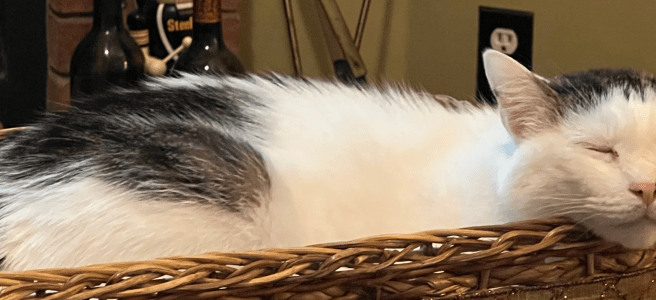
From the Box to the Basket

Today marks three years since Edgar Allan Poe strutted out of Princeton’s Meow and into our lives, and, let’s be honest, took over the place. Three years of “good, good boy time,” midnight zoomies followed by the 3 a.m. delivery of a wet mouse toy to my chest or head, and a perfectly curated collection of stolen tampons, chapsticks, hair ties, mouse toys, and other bits and bobs he has deemed worthy of play, all artfully scattered around the house and tucked under the couch.

Poe started life as a stray in Laurinburg, NC. A woman took him in and even documented where and when she found him. Unfortunately, like so many in our society, she struggled with mental health challenges, and her desire to help stray animals turned into a devastating hoarding situation.

Three years ago, authorities seized the animals in her home, over 50 cats kept in cages stacked on top of each other. I’m told it was one of the worst situations they had ever seen. Poe spent the first two years of his life like that, caged in a garage, sitting on top of and under other cats.

He never saw the sun. He never ran after fuzzy mice, never had healthcare or regular meals. The only floor he knew was a wire grate. The only bed he knew was that same wire grate. Most of the cats they rescued could not be saved and had to be humanely euthanized. But Poe… Poe endured.

He was sent to Mac Tabby Café in NoDa, where they posted a bio of him on their Facebook page. They called him Nick Barkley. I don’t know why, I imagine it must be hard naming the hundreds of animals that come through their doors. But something in that image, that story, and those yellow eyes hooked me.

At the time, I had two cats at home: Stella Sugaree Garcia Blue and Dan the Adventure Cat Rooney. You might remember them from this story. Still, I had been quietly searching for my next true love, Stu Two if you will, and something in that gaze told me I had found him.

Maybe it was his coloring, all white with a few black spots and a black tail, a Stuesque remix with black where the orange had been. But I think it was more than that. In that photo, I saw a cat, call me crazy if you want, who was a fighter, a survivor. He wasn’t hiding or cowering in some corner. He was bold, upright, ready for the next episode, ready to tackle whatever life threw at him next. And I knew, whatever that was, I wanted to be there for it.

It turns out that, like most things in my life, it came with unexpected injuries. Three days after being removed from a cage and set free in a cat café, Poe (née Nick Barkley) jumped off a table and broke his leg.

They reached out to let me know I couldn’t come see him and that he would be in traction and unavailable for at least two months while he healed. It hurt, but I wasn’t deterred. I kept tabs on him as they moved him to Princeton’s Meow, a wonderful cat rescue in my hometown, while he recovered.

The only downside was that he was now back in a cage with a casted leg. His first taste of freedom had been short-lived. We visited him a few times at Princeton’s and got to love on him while he sat there, little leg in a cast, in a crate. He was so receptive to the attention, purring nonstop and rubbing his head against our hands, always asking for more.

Finally, after almost seven weeks of waiting, I got the email I had been hoping for: Nick was ready to be adopted. The message came on July 31, but we were going out of town that week, so he had to wait until August 8 for us to officially bring him home.

I set up the appointment and planned to pick him up at Princeton’s after my dentist appointment that day. We prepared the bedroom for his arrival, knowing we’d need to keep him quarantined and do a slow introduction to Rooney and Stella. Then we started counting the days.

The day I was bringing him home, I went to work with my cat carrier in the back seat. I had a dentist appointment around four to get a filling replaced, but that wasn’t going to stop me from getting my boy.

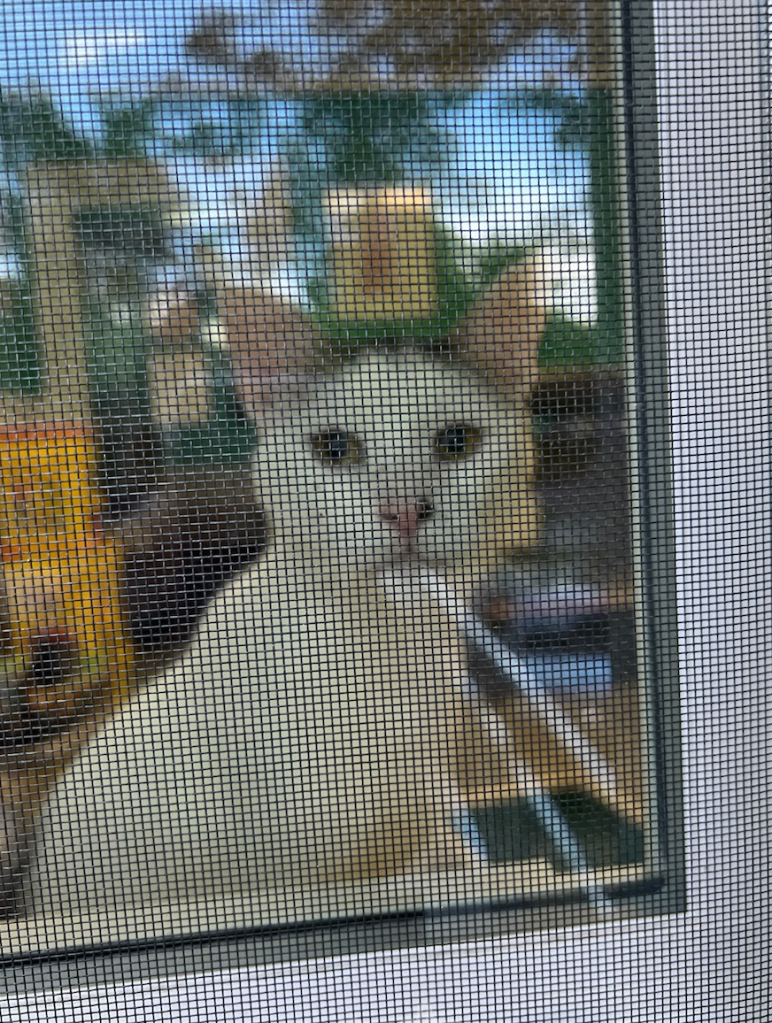
I pulled into the lot at Princeton’s and, as I was putting my car in park, a face popped up in the window.

It was Nick Barkley. It was like he had heard my car and somehow knew it was his ride to a new life and freedom. They were busy that evening with intakes and let me sit in the room he was in while they finished their work.

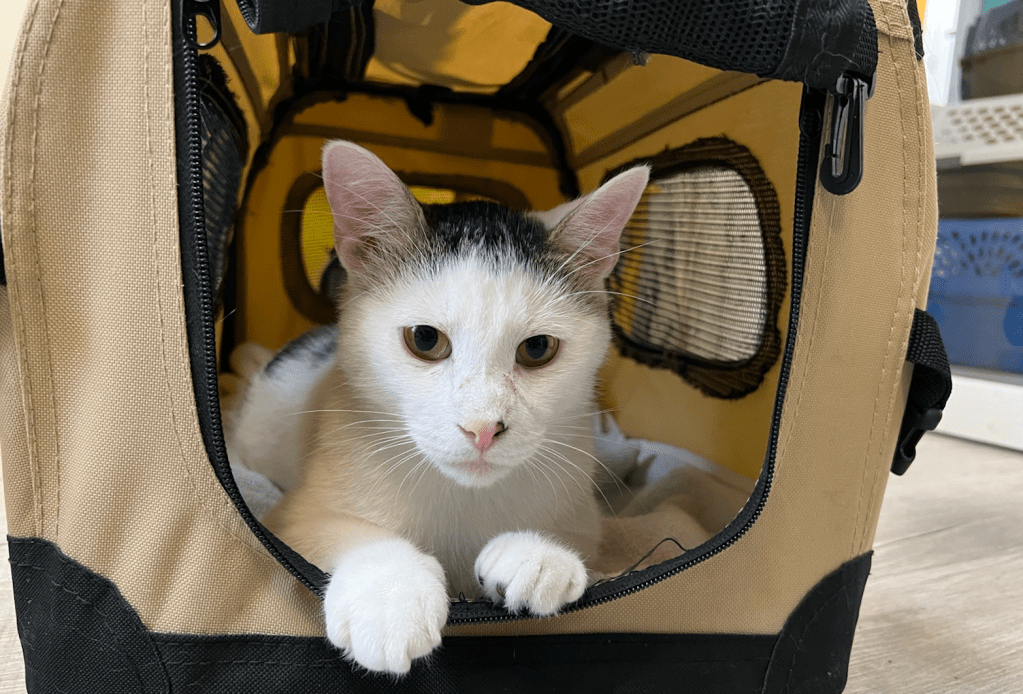
I waited to complete the paperwork and pay the adoption fee to take him home. There were about ten cats in that room. All of them came over, wanting pets and to play. But not Nick. He walked into the cat carrier, despite spending two years in one, and laid down. It was like he knew, this is my mom.

He came to us a little unsure, a little aloof, like he wasn’t quite convinced we were worthy of his time. We kept him in the master bedroom behind a closed door so we could ease all three cats into the transition slowly.

After about a day, he was no longer thrilled with his confinement. That night, when I used my leg to block him from escaping as I shut the door, he jumped up and nipped me on the wrist. I was startled. I remember gasping and feeling the hot sting of tears in my eyes. I’d never been bitten by a cat that wasn’t playing.

Ten minutes later, I tripped over him getting into bed and he jumped up and bit my leg. That really sent me spiraling. I was upset and unsure. I knew I hadn’t made a mistake, but I was afraid I had adopted a cat that wouldn’t be able to be socialized.

I reached out to Princeton’s, curious about his background and whether they had ever had issues with him. I assured them I wasn’t returning him, that we would stick it out, but I needed advice. They told me he had never displayed any aggression and that they were as surprised as I was.

In the end, I decided it wasn’t aggression. He was advocating for himself in the way he knew how. He wasn’t being mean, he didn’t break the skin, it didn’t even hurt, well, just my pride. It was his way of letting me know, “I’m here, I’m unhappy, and yes, a bit scared.” It was the first and last time it ever happened.

Naming him proved to be about as difficult as it was to name Rooney. I knew we didn’t want to call him Nick. My cousin is Nick, and I didn’t want a cat sharing the name of my favorite male cousin.

He was almost all white, so we called him Spooky for a bit, mostly because T found his bright yellow eyes a little off-putting. We called him Possum because my sister thought he looked like one, and to be fair, he kind of does. We called him Monkey because he reminded my BFF Morgan of Marcel from Friends, and again, he kind of does.

But none of those felt right. About two weeks into our life together, I was curating an ELA lesson on poetry and prose and I came across a picture of Edgar Allan Poe. Maybe you don’t see it, but we did. He has that same stare. That same “my mom cuts my hair” look. The expression, the eyes, even that slightly serious “I’ve seen things” energy.

And it was settled. Nick Barkley became Edgar Allan Poe. Poe, PoePoe, Poebert, for short.

I wish I could say that introducing him to the girls was smooth sailing, but it wasn’t. Even now, I’m pretty sure Rooney still hates him, and maybe us just a little, for bringing him into what had been a pretty normal and peaceful existence.

He and Stella get along well enough; they’ll play together, but she’s his age and can keep up with him. Rooney, on the other hand, has taken a different approach. They’ve settled into a relationship built mostly on mutual avoidance, with the occasional moment when he decides to stalk her and she promptly kicks his ass. Honestly, I think he’s more afraid of her than she is of him. He knows she isn’t to be trifled with.

Then there was the litter situation. We had a carefully curated system that worked beautifully with pellets in every box, no smell, easy cleanup. Poe refused to use them. His protest forced us to switch one box back to clay litter, which we all hate.

To make matters worse, he developed an irrational fear of the Litter-Robot. That led to accidents in the house and a lot of cursing over a $500 litter box rendered useless by one insolent child.

Even after three years, he’s still weird, still a bit standoffish. He doesn’t let me hold him like Stu did. He doesn’t cuddle. He isn’t a lap cat. I’ve had conversations with him about it.

Sometimes, by accident, we call him Stu. It’s a slip of the tongue, a memory, and a pain that time hasn’t completely erased. So he knows that, through no fault of his own, he is a replacement cat. In some strange way, he is Stu Two. But he’s fine with that, because he also knows I love him for him. He knows I know he isn’t Stu. Still, there are moments when the guilt creeps in.

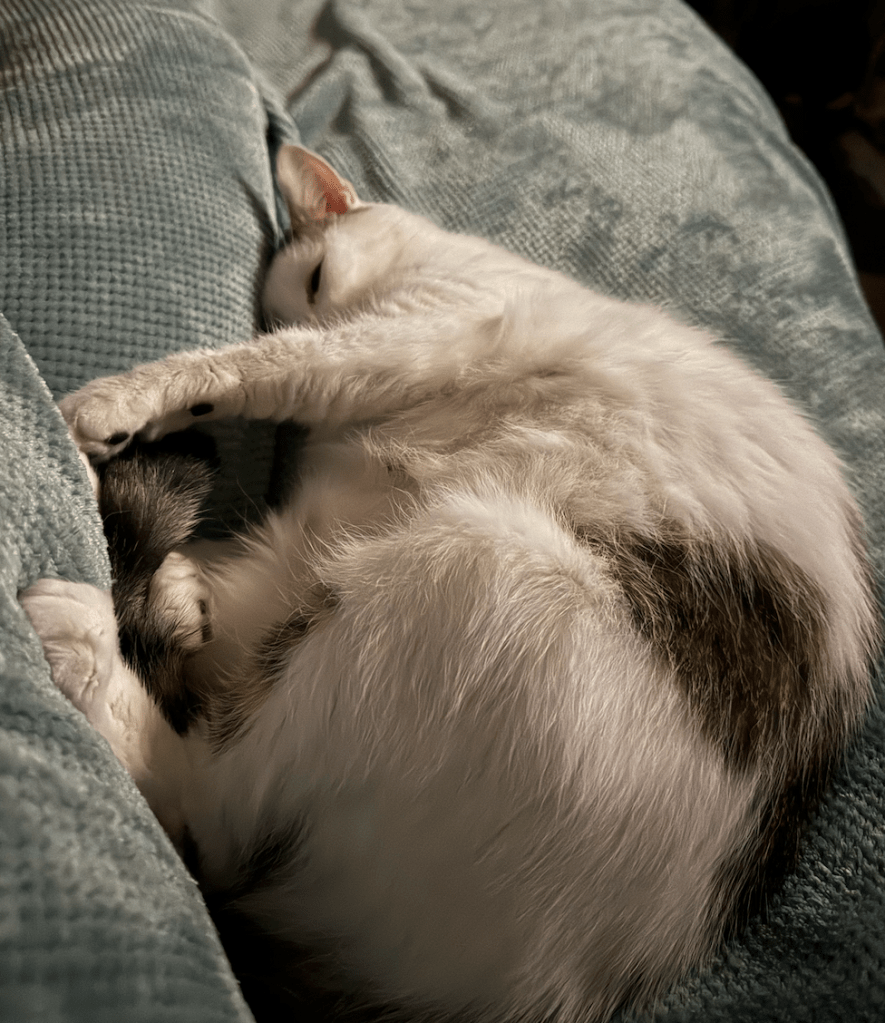
And now? He supervises everything I do, from laundry folding to dinner prep, positioning himself just far enough away to watch with judgment but close enough to insert himself if he feels like it. His daily naps sprawl across the house like feline performance art, deep and unguarded.

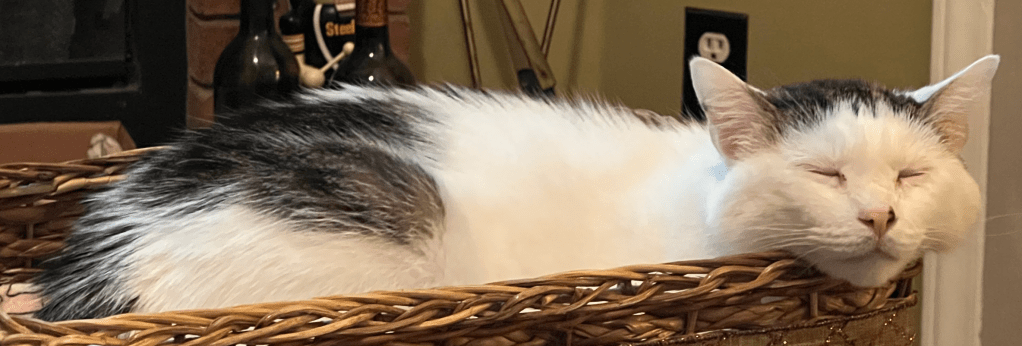
He has a basket on the coffee table where he can nap or watch TV (and yes, he really does watch TV) and be close to us, but not on us. It respects his personal space, something he values greatly, and he will remind me of that, gently, when I press my face into his.

Time heals all wounds, even the ones a cat carries after two years in a cage. Sometimes, when he’s in his basket and I call him, he’ll come and sit on my chest on the couch. He doesn’t stay long and he won’t let me pull him into an embrace, but we are slowly making adjustments and moving in that direction.

He sleeps near the door on the couch and greets me when I get home. He will roll over and show me his belly, though touching it can still be a gamble. He chirps when I open a can of food and knows exactly when it’s dinner time. He comes running every morning for his “coffee treats” and perks up at the sound of a Churu being opened in the evening.

The best thing about Poe is our nightly routine. I call it “good, good boy time,” and it’s become a running joke at the office because I’ve talked about it so much.

Every night, and I mean every night, when it starts to get close to my bedtime, usually around nine, Poe begins to get antsy in his coffee table basket. Every time I walk down the hallway he sits up and waits for me to call him.

When I am finally ready for bed I say, “Ok, Poe, it’s good, good boy time,” and he jumps up, follows me down the hallway, and hops onto the bed. We spend about ten minutes playing and getting pets, and then I lay down on my back and he crawls onto my chest to lie down.

He only stays for ten or fifteen minutes, but it’s enough. I’m a side-sleeper, so if he stayed longer I’d never get any rest. Sometimes he moves to the edge of the bed and sleeps there. Most nights, he sleeps with T and Stella, which annoys me, but what can you do?

Every morning, before my alarm goes off, no matter what time it’s set for, he comes back about ten minutes before it’s due to ring, crawls onto me, and settles in. I think it’s his way of asking me to stay just a little longer.

I know I’m just setting myself up for heartache in the end. I didn’t want to be here. I didn’t want another Stu. But I’m human, and these sorts of attachments and this sort of love are what make us unapologetically real and raw. I don’t regret it, even if I sometimes fret about it.

And Poe, that little cat in a box, stole my heart all over again, for all the same reasons, and for all the different ones that Stu did.

No matter what, he is Poe: independent, particular, a little mysterious. But in the three years since he came home, the edges have softened. He trusts me now, in his way. And sometimes, when he sits in his basket and blinks slowly at me, I think maybe he’s saying, “You did okay, Mom.”

Adopting Poe was one of those decisions that made the whole world feel a little softer. He’s proof that rescue cats rescue us right back. Here’s to many more years of purrs, headbutts, and unapologetic bed-hogging.

Happy Gotcha Day, Poe, three years as a free-range kitten, and you’ve perfected the art.

A Feral Kind of Grace

A Feral Kind of Grace
An Introduction

I was a barefoot child with skinned knees and a bike. A dreamer. I spent my days wandering wooded backyards and whispering creeks, convinced the trees could talk if I just listened hard enough. I grew up in a house where silence was both sacred and suspicious, where love was present but not always soft. I learned early how to be useful. How to read a room. How to disappear—and still be watching. I longed to ride horses on the sand and hear the stories the stars were waiting to tell.
I learned to look.
I learned to listen.
I learned to fight.

In my teens, I wanted to be everything at once—pretty, smart, daring, good.
I failed at most of it. Spectacularly and often.
I fell in love too fast, burned too hot, gave too much, and had my heart broken twice into so many pieces I never thought I’d be whole again.

I wrote poems in the margins of my math homework and still day dreamed about horses and far away places. A testament to my math ability now. I carried secrets in my soul that I would whisper to the stars at night as an offering. I wore armor made of sarcasm and kindness, hoping no one would see how much I wanted to be seen and accepted.
I played sports, earned mostly As, and frustrated my teachers with my questions and inability to sit still. I stopped listening. I stopped looking. But I didn’t stop fighting.

I went to college at 17—young, free, and determined to be someone else. I rewrote my name and my story numerous times in the span of 5 years. Each fractured being still clinging somewhere inside me today. I had moments of great success… and moments we still don’t talk about when the family gets together. I don’t live with my regrets, but I have them. I came out mostly unscathed and mostly whole, and wholly scared of life in the real world.

Early adulthood didn’t make anything clearer or easier—it just raised the stakes.
I was more momentum than foresight. I got engaged, broke that off. I married too soon and I stayed too long. I made lifelong friends, and lost touch with the brokenness inside me. I gathered names and scars and learned how to leave.
I learned I was strong enough to be alone.
I went back to school, accumulated degrees and the debt that came with them.
But I also learned how to stay.

Somewhere in the middle of all that, I found my person.
Not the one I expected—but the one who made space for every version of me I’d been carrying.
The one who didn’t flinch when I unfolded. He wasn’t the person I wrote, he was the person I re-read. And I started listening again. I started seeing instead of just looking. I didn’t stop fighting.
But I did learn to let go.
I’ve learned to apologize. To move forward.
To move on.

And now?
At 47, I’ve made my home somewhere between squirrel whisperer, crazy cat lady, reluctant domestic goddess, and freelance adventurer.
I try to be a good neighbor—I’ll bring in your mail, water your plants, or loan you a cup of sugar.
But I also leave snacks out for the raccoons and possums. T calls it “yard garbage”. I refuse to rake leaves—for the bees, sure. But also because raking feels like erasing. And my weekends are not meant for labor. I have a menagerie in my yard and my own squirrel army. They have names. They know me, and I know them. One year, I had to apologize for the corn that started growing in random places around the neighborhood. I’ve since switched to peanuts.
They haven’t sprouted—but not for lack of enthusiastic burial.

I like things a little wild.
I thrive in the casual chaos I’ve perfected.
My garden is unkempt and honest but always full of mint.
My house is full of books, mismatched mugs, lonely socks, and stories I haven’t told yet.
I pick up a rock from every place I visit—and I can name them all if you ask.
I’m stitched together with equal parts wit, mayhem, grief, and grace.
I’ve softened with time.
But I still bite when cornered.

I write because I have to. There’s something ancient and restless in me that insists on being translated and heard.
I edit because I want to. Because I believe words can be shaped like prayers or knives—depending on what’s needed.
I never believe the work is done.

My writing lives at the intersection of memory and invention.
It is rooted in truth—even when the story is fiction.
Especially then.

I have an alter ego named Echo.
She reminds me to write when I forget.
She holds up a mirror when I’m trying to disappear.
Most days, she just reminds me to feed the squirrels.

This is where the stories begin.