This Is Forty-Eight… Forty-Nine?

Another trip around the sun, another year older, and somehow, it still catches me off guard. Birthdays don’t make me sentimental anymore; they make me aware, of time, of motion, of all the ways I’ve changed and stayed the same. Forty-eight feels too young to feel this wise, too old to feel this curious. But here I am, somewhere in between, still learning what it means to live wide open.

Thank you to everyone who took the time yesterday to wish me a happy birthday.
Hard to believe I’m forty-eight… wait, forty-nine? No, forty-eight. I think. Anyway, it doesn’t matter.

Sometimes I panic when I think about things like, “In 2030, we’ll install new social studies standards.” Not because of the standards, but because of the 2030. I can still remember partying like it was 1999 when it actually was 1999.

I remember being ten, with parents who were forty, and thinking they were ancient. Now, with parents who are seventy-eight and seventy-nine (I’m forty-eight, nailed it; my mum is thirty years older than me), I think about how young they still are and how much time we still have left to travel and explore.

I no longer measure time in minutes and seconds. In frat parties or nightclubs or boys. I think in weeks, months, and years. About retirement plans and portfolios. Menopause and hip replacements. I curse at my phone, send words instead of memes, and laugh because, well, here I am, the person my parents warned me about. The person they swore I’d become.

I went from wild and carefree to achy and crotchety seemingly overnight.
I turn down the music when it’s raining too hard because I can’t see well when it’s too loud. I brace for the “oof” every morning when I crawl out of bed, my knees, hips, and back punishing me for the years I punished them in sports, and in stupid (but also fun) things like Spartan races.
I track BOGO sales at grocery stores and make meal plans instead of eating leftover pizza I found on my dorm room floor or tacos I found under my pillow.
I still love unsensible shoes, but I only wear them when it’s sensible.
I haven’t yet started calling the front desk when the room next door is too loud, but I might have knocked… politely… on the wall once or twice.
And I definitely don’t have TikTok.

Sometimes I stumble across old photos from college, me in my purple plastic skirt, that shiny green jacket (also plastic) I thought made me invincible, and I wish I could tell that girl how beautiful she was before the world convinced her she wasn’t. How thin she was. How unbreakable she’d turn out to be.

I wish I could tell her that strength doesn’t come from holding everything together; it comes from falling apart and finding a way back. That every wound, even the ones that felt fatal, would scab over and diminish in time. That the broken hearts and tear-soaked pillows, the stupid boys and stupid girls and cruel words, would one day shrink down into stories she’d tell with a laugh.

I wish I could tell her the world wasn’t ending every time someone ghosted her, or when she cried herself sick over someone who probably sells insurance in Ohio now and hasn’t explored the Rocky Mountains alone. That those sleepless nights were wasted on people who didn’t deserve to know her favorite songs. That those long nights waiting for the phone to ring were keeping her from hearing herself instead.

And that those wounds, now faint scars, would become the very fabric that built her. How every break had taught her to bend. Sturdy, imperfect, a little frayed in spots, but hers and hers alone. The kind of fabric that softens with time yet still holds up after every wash. The jeans you still wear from high school. The T-shirt that almost smells like him. The thread that runs through every version of herself, binding the girl she was to the woman she became.

If I could, I would pull that thread tight, trace it back to where it started, and I’d find her again, the girl who didn’t yet know what she was made of. I wish I could tell her that one day she’d grow up, be respected, earn a doctorate, and realize the people she once tried so hard to impress no longer even exist in her memory.

I’ve said before that while I have regrets, I don’t live with them, and that still holds true. They’re memories, not weights. Reminders, not anchors.

At forty-eight, I feel lucky to be where I am.

I have a handful of really good friends, the kind who’ve seen me at my worst and still answer the phone at two in the morning if I call in a panic… or a rage… or just because I’m bored. They send me pictures of otters, leave voice memos of themselves singing on my birthday, drop off authentic All Dressed chips on my doorstep, send random memes about leaves and how much the bitches love them, show up at my dissertation defense at eleven o’clock Netherlands time, still cut and style my hair, or jet off for a weekend in Vegas that we still don’t talk about. They visit me in Charlotte when they’re passing through, or maybe just to curl for the weekend, and leave little gifts on my desk because they thought of me and my ridiculous obsession with all things cats.

I have a best friend. The kind who calls when I’m too sad to talk, sits in silence while I cry, and only hangs up once she knows I’m in bed. The kind of friend who travels with me, who knows my darkest secrets, my worst impulses, my deepest fears, and still always shows up. She calls me on my shit but never judges me… at least not too harshly… and she always calls me back.

And I have a partner who celebrates me, ignores my tantrums, and indulges my weird whims. Who takes trips with me on the off chance we might see moosen. Who sometimes makes a steak dinner better than anything Ruth’s Chris or Morton’s is serving up, and who always drives me to the airport when I’m off on another adventure, kisses me goodbye, and reminds me that he loves me.

I’d go to the mattresses for all of them without a second thought, because, frankly, several of them know where the bodies are buried and because without them, I’d be lost.

I have a family that is mostly intact. I’ve felt the loss of matriarchs and patriarchs, of beloved uncles and family friends I once thought of as surrogate parents. Each loss has become a reminder of family itself, of love, of togetherness, of how deeply we belong to one another even as the seats around the table begin to empty.

Despite my general optimism, I’ve started to live more in the now, because I’ve grown acutely aware of borrowed time and the absence of any guaranteed tomorrow. I sometimes wish I’d understood the meaning of family when I was younger, but I’ve come to learn it’s something that has to grow on you over time, like moss… or maybe fungus. You have to grow old to understand what old means. You have to experience loss to comprehend the hollowness it leaves behind. And you cannot fully understand love until you’ve stepped out of the light it once provided. But each loss, in its own way, brings you closer to those who remain in the void and learn to share that space with you.

But through it all, I know I have a place to call home, even if it isn’t brick and mortar or tied to a single point on a map. Sometimes family is forty-seven text notifications bitching about the Penguins’ power play.

Home, like family, isn’t always simple. Love and belonging come with their own messiness, their own friction. Because comfort doesn’t erase complexity. Family, like time, teaches in layers; some soft, some sharp.

I’ve also felt the strain that politics and pride can bring to a family, and I’ve lamented the silliness of those silences. The stubbornness that builds walls where laughter used to live. Yet even those moments have carried lessons. I no longer see myself as a child at the whim of adults trying to mold me, or as an adult bending to other adults who believe they still can. It’s a strange dance. The old and the young, elders and youngers, respect and mutual understanding. Learning to be cautious and kind, yet steadfast, confident, and self-advocating. It has taught me to love without question or condition, and to forgive, but never to cave.

The same lessons have found their way into every other corner of my life, especially my work.

I have a job I enjoy and take pride in, work that still challenges me, that still matters. The kind of work that sometimes keeps me up at night and wears me thin, yet always reminds me I’m part of something bigger than myself, that my days are spent doing something that outlives the hours it takes.

I’ve finished my education as far as degrees go, but the learning hasn’t stopped, it’s just changed shape.
Now it looks like airports and conversations and quiet mornings where the lesson is simply being present.

I travel. I wander. I wonder. I explore.

Not to escape, but to keep learning what it means to be alive in all the small, ordinary ways, because the world keeps getting bigger the older I get, and each place teaches me something new about who I was, who I am, and who I’m still becoming.

Because no matter how far I go, the journey always circles back to me. Every new horizon holding up a mirror, reminding me that growth isn’t just about the miles traveled, but the grace earned along the way.

I still sometimes cry into my pillow, and I know heartache doesn’t fade with age, but I also know it isn’t the end of the world. It just shifts the landscape. And it’s up to me to decide how I want to walk it.

To all the little girls and boys out there, the ones who think thirty or forty is old, just wait. It really does get better with age. You get better with age.

If you have a dream, chase it. If you want to go somewhere, buy the ticket. Money is something you can always make tomorrow, and things just gather dust. Real living happens at the intersection of let’s do it and holy shit, I’m terrified.

So do it scared. Live life on the precipice between caution and the wind. That’s where the good stories come from anyway.

Because that’s the secret no one tells you about getting older, it’s not about slowing down; it’s about finally knowing when to jump.

In the End, It’s Up to Us

This isn’t a political post. It might seem like one. But that depends on the eyes and the lens with which you choose to read it. This is a post about humanity. About citizenship. About our rights and responsibilities in this great nation. This is a post from one human to another, hoping to appeal to all of us, regardless of where we fall on the political spectrum. Regardless of who we did or did not vote for. Regardless of our biases, our fears, our worries, or our convictions.

This is a post that asks you, as a person, to stop, reflect, and consider what comes next. Because what comes next is what will define us—and you—as individuals and as a nation. This election didn’t determine the fate of our country. We determine that. We have that power. That is what democracy and a Constitutional Republic are founded upon. It is up to us to decide what comes next and how we choose to behave in the coming months, years, decades.

Do not forget: this country was founded on the premise that the government works for us. We’ve had a tumultuous few years, and we are coming off an election that was pivotal, poignant, and a turning point. But regardless of what you won or lost, who you voted for or didn’t, the work doesn’t end on election day. The work is just beginning.

You want a better America? We all do, even if we don’t agree on what that looks like. But divisive vitriol and hatred won’t get us there. Now, more than ever, we need to put derision and hatred aside and come together. When you make a decision, ask yourself: Am I only thinking of myself, or am I considering my neighbor, my friend, my family, my butcher… in other words, am I thinking of the greater good?

Democracy and our government were based on the greater good, on limited government and the protection of minority rights. Our country was born from the desire for freedom from persecution and a lack of voice. It was founded on the belief that all men (and women) are created equal, with inalienable rights. We were once a proud nation of Enlightenment philosophy and high expectations. We held people accountable and loved our neighbors.

So, before you act, before you do anything else, take a moment. Reflect. Imagine the country you want to live in and be proud of. Imagine your neighbor, your friend, or the stranger you pass on the street. What makes a nation great? What makes us strong? Seriously consider how you can have an impact and choose to work for good. Make decisions out of hope and promise, not fear and despair. This nation isn’t defined by one person. Each of you has a place and a voice. Use it wisely.

We are all on this ride together, divided or not, and the destination is in our hands. Choose love over hate, compassion and empathy over anger and belittlement, action over passive aggression. Be a willing, noble participant in democracy. Don’t give up. Don’t walk away. Don’t lower your gaze.

Do not be afraid of what you don’t understand. Fear only leads to hate and breeds contempt. If something frightens you, face it—ask questions, seek understanding, learn. It is not for us to be judge, jury, and executioner. There are other worlds than this, and greater powers at work. Our role is to make good on the time we are given, to abide by the principles that guide us: love, honor, and value. The rest will sort itself out, if you believe in that. And if you don’t, there’s still the golden rule we all share: “Do unto others as you would have them do unto you.”

There is no God, no higher power, and no man who can or will excuse or condone hatred. The teachings of Jesus, of other prophets and religious figures, of parents, heroes, or guides in our lives have been clear: there is no justification for violence against another. We do not condone hate. We do not condone violence. Whatever our belief system or upbringing, each of us has been taught love at some point.

We are given free will to choose our path, and eventually, we will all be judged by what is in our hearts—whether by a higher power we believe in, or by the legacies we leave behind. With this free will, each of us must decide how we will act, how we will treat others, and what kind of world we wish to create.

Ultimately, it’s not about the beliefs we hold, but the way we live them out. Choose to be a force for good. Choose to rise above fear and meet the unknown with curiosity and courage. Because in the end, our actions define not just who we are, but the world we leave behind.

Why NOT Harriet Tubman?

The latest social media rant seems to be centered around the federal government’s decision to remove Andrew Jackson from the twenty dollar bill and replace him with Harriet Tubman. I read something on Facebook the other night where someone queried, “out of all the great black people that made a difference does any one know why they chose her? Just wondering.” Screen Shot 2016-04-21 at 10.19.13 PMIt was an honest question, I don’t think he was being a jerk about it or anything. It just got me thinking… And that got me trolling…And that got me writing…(I’m worried this is going to become a habit).
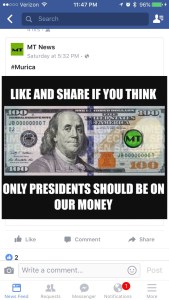
As I searched sites like Twitter, Instagram, Facebook, and Breitbart News (that is a horrid and terrifying place), I noticed three common themes emerging among the dissenters, 1) IMG_7740Harriet Tubman is ugly, 2) This is just one more plan by President Obama to ruin our nation (I think the term Obamanize was actually used), and 3) Most of the people complaining don’t have the faintest clue what it is they’re actually complaining about. Take the meme on the left. I seriously cried laughing. Now, the original poster, MT News, meant this as a knock against the current social media outcry over the Tubman decision. BUT, as it has been passed about the webs it has become a representation of hatred as more and more people share it because they believe the sentiment behind the wording, rather than understand the irony behind the image.
I’ve been trying to understand this situation and in order for me to do that, I need to break down each of the themes individually and view them through personal, historical, and social media lenses.

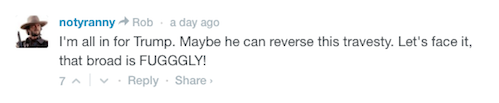
1) “Let’s face it, that broad is FUGGGLY!”

Screen Shot 2016-04-26 at 8.49.10 PM.png
From Breitbart News (Scary, scary place)

Screen Shot 2016-04-26 at 9.07.30 PM.png
Another Breitbart gem, at least guy doesn’t have an issue showing the world his racist side.

Screen Shot 2016-04-26 at 4.14.44 PM.pngScreen Shot 2016-04-26 at 4.15.13 PM.png

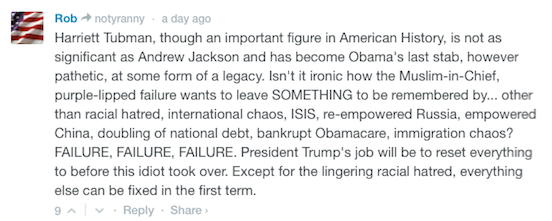
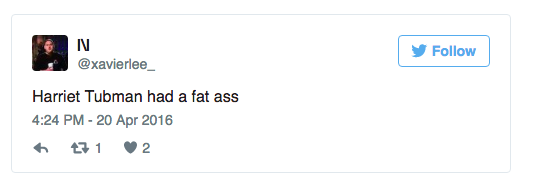
These are some of the many random comments and tweets I took screen shots of regarding the strange fascination Americans seem to have with how ugly Harriet Tubman is. I’ve lost count of the amount of times people commented on her “fat ass”, ugly face, and bad hair. The comments range from mildly annoying to downright racist. I personally don’t see the purpose of this logic. I mean, I agree, she’s not a looker, but neither am I. Hell, neither is most of the American population. Furthermore, what do looks have to do with her accomplishments or worthiness of being the face of the new twenty dollar bill? I could see this being a tad more logical if say, Ben Franklin or Abraham Lincoln were even remotely good looking, but let’s face it, our Founding Fathers and former presidents don’t often have that going for them as a trait. I have to believe deep down that America can’t be THAT superficial which means I AM choosing to believe that America IS that racist. I firmly believe these tirades are driven by ignorance, by the fact that deep down these people are pissed that a black woman is replacing a white man and while some show it more willingly than others, they have to look for seemingly less offensive ways to complain about the new face of the twenty.

Screen Shot 2016-04-21 at 10.03.55 PM
One of the best responses regarding the argument that Tubman is too ugly to be on US currency

2) “Obama’s Last Stab”

Screen Shot 2016-04-26 at 9.07.15 PM.png
Breitbart News again, this guy doesn’t seem to hate Tubman as much as he does Obama, but it’s hard for me to not read “racist” into this comment.

Screen Shot 2016-04-26 at 9.10.48 PM.png
This guy believes this is the direction America is headed because we’re putting a black woman on the 20 dollar bill.
Somehow people in America have decided that this move toward equality in our currency is actually an evil and secret plot by the President to…to…to do what exactly? I’m going to guess it has something to do with the belief that President Obama is planning to take power from the “good, God-fearing, white Christians” of this “great” nation. The problem with this sentiment, aside from the obvious racism again, is that it’s just not true. People have been lobbying for years to get women, black people, Native Americans, and other minorities on US currency. Hell, in my research I found several failed attempts by House Representatives to get Ronald Reagan on the 10, 20, and/or 50 dollar bill. I have to wonder, if that was who was replacing Andrew Jackson would we be having this conversation? Also, as an interesting side note, people have been lobbying for years to have Andrew Jackson removed from US currency, school names, postage stamps, etc. In other words…NONE of THIS is a new idea folks. Furthermore, NONE of THIS is even something the President of United States has the power to control.

According to US law it is usually the Secretary of the Treasury (yes, I know, he WAS appointed by President Obama, but he was also APPROVED 71-26 by the US Senate…which means…that’s right…Republicans said yes too…) who determines which people and which of their portraits appear on US currency. However, legislation passed by Congress can also determine currency design. That doesn’t mean the President can’t make requests or suggestions regarding the matter, but it does mean HE CANNOT put Tubman on the twenty, regardless of whether he wants her there or not.

This most recent push for changing our currency had great help from a grassroots movement called “Women on 20s“, who gathered support for their cause and then petitioned President Obama to “instruct” Jacob Lew to put a woman on the twenty dollar bill. After a year of work, and the collection of hundreds of potential names for this honor, Jacob Lew, the Secretary of the Treasury, made the decision to honor the women’s suffrage movement on the 5, 10, and 20 dollar bills. Lew wrote a letter to the American people detailing his decision. By 2020 the plan is to have added women, white and black alike to the 5, 10, and 20 dollar bills. (By the by, 2020 marks the one hundred year anniversary of the 19th Amendment, which gave women the right vote).

3) We the People need a history lesson…

So now we’ve sort of come full circle, returning to the question that started me on this path, “why Harriet Tubman?” In my infinite wisdom, I decided that in order to understand “Why Harriet Tubman”, I had to first understand why any of them, so I started my research with the question, “why the presidents on the money?” I was curious. I learned a lot, including this, which actually surprised me.

Treasury Department records do not reveal the reason that portraits of these particular statesmen were chosen in preference to those of other persons of equal importance and prominence. By law, only the portrait of a deceased individual may appear on U.S. currency and securities. Specifics concerning this law may be found under United States Code, Title 31, Section 5114(b). (http://www.moneyfactory.gov/resources/faqs.html)

Basically, at least according to the Bureau of Engraving and Printing, part of the US Department of the Treasury, there really isn’t an answer as to why the men who grace our current bills were “lucky” enough to have their mugs picked in the first place. There IS a lot of speculation out there. Some of it from highly intelligent and respected people, and some of it is just downright entertaining, in a sad, I hope that person doesn’t procreate sort of a way.

Taking all that into consideration I think we can safely say that Presidents Washington (one dollar bill and quarter), Lincoln (five dollar bill and penny), and F. Roosevelt (dime) are sort of no-brainers. I mean you have the hero of the Revolutionary War and first president. The Great Emancipator, the man who preserved the Union and was then assassinated a mere five days after Lee surrendered. And the man who got the US through the Great Depression and who was so well-loved they elected him four times. That’s a pretty strong list of solid contenders to be the visage of our money and I’m going to give all three two thumbs up in snap as my solid seal of approval.

The lines start to become a little blurred when we consider the rest of the “currency crew” (I like that little nickname I gave them) Ben Franklin (hundred dollar bill) and Alexander Hamilton (ten dollar bill) were not presidents, which as was noted above, does seem to matter to some people. Brushing that aside though, we have two men who were Founding Father’s of the United States and ardent supporters of independence and the federal government. Ben Franklin actually used his own personal printing company in 1739 to develop methods to make counterfeiting bills more difficult. He used leaves to create raised patterns on the bills, a practice that has been modified over the years and is still in use today. Hamilton is probably best known as the man who shot and killed Aaron Burr. But he was also the first Secretary of the Treasury under George Washington and a major supporter of a national banking system. Bearing those characteristics in mind the lines regarding those two aren’t really all that blurred, so I’m also giving these guys two thumbs up and my approval as currency portraits.

Blurrier still become our lines as we move on to Ulysses S. Grant (fifty dollar bill) and Thomas Jefferson (two dollar bill and nickel). Grant was the 18th President of the US and is generally considered a war hero from the Civil War, instrumental in the Union’s success against the Confederacy. Grant was a graduate of West Point Military Academy, one of the most prestigious colleges in our nation. On the flip-side, Grant’s success as a military strategist is highly-contested and many historians and military experts argue that what won the war was not brilliant strategy so much as his willingness to expend as many lives as possible to win the war. His war of attrition against the South earned him the nickname “the butcher” in many circles. His performance at West Point was less than average and his interest in military studies was lacking. Many historians have also recorded Grant’s presidency as a failure. His economic policies led to a depression and his involvement in the Credit Mobilier Scandal further sullied his reputation and legacy. Grant’s tenure in office wasn’t all bad, he laid important groundwork in regards to civil rights and worked toward the Reconstruction of the nation. He was president during a tumultuous time in history, so while he doesn’t get an enthusiastic two thumbs up from me (and DEFINITELY no snaps) I’m not going to say he didn’t earn his place on the fifty.

Thomas Jefferson was the third President of the United States. He was also our second Vice President under John Adams and our first Secretary of State under George Washington. He penned the Declaration of Independence and is one of our greatest Founding Fathers. TJ picWhile in office Jefferson organized the Louisiana Purchase, doubling the size of the US and sent Lewis and Clark on their mission to explore that new territory. He stood up against the British and signed into law an act forbidding the importation of slaves into the United States. His policies toward Native Americans were seen as more humane than most (for the time period) and he believed in a policy of assimilation for most indigenous people. He is regarded as one of the greatest presidents of our country. BUT…Jefferson was a slave owner. He participated in the buying, selling, and inheriting of slaves. He owned over 600 slaves in his lifetime and supposedly had an affair with one of his slaves, Sally Hemings, who bore his illegitimate children. In all honesty, Jefferson is one of my favorite presidents, but there is definitely room to debate his position on our current currency because of his role in slavery.

Which leads me to our final currency portrait, the current man of the hour, Andrew Jackson. The blurriest of all lines rests here with the 7th President of the United States and Battle of New Orleans, War of 1812, hero. Andrew Jackson has been one of the most debated, most controversial, most celebrated, and most loathed presidents in our history. He was an avid politician and involved in numerous highly politicized issues including the “corrupt bargain”, and the subsequent creation of the Democratic Party, the Nullification Crisis, the killing of the National Bank, and The 1830 Indian Removal Act which later led to the “Trail of Tears”. In the election of 1832 he assumed the “jackass” as his symbol (his opponents called him that) and later Thomas Nast would popularize this symbol and it would become the emblem of the Democratic Party. He was a slave owner and slave trader and a known opponent of abolition. Many have argued that Andrew Jackson was a horrible person, not worthy of a place on our currency. Many have argued that Andrew Jackson was a great politician who prevented civil war and federal bankruptcy. I argue that isn’t it possible he was both?

AJ Jackass
Political Cartoon portraying Andrew Jackson as a jackass, circa 1929
Jackson was politically active in the 1820s and 1830s, a time period wrought with racism against both African Americans and Native Americans. A time period characterized by the desire to head westward because it was God’s will and plan for us as a nation. He was a man of the times. It doesn’t make it right. It doesn’t make him right. But it does lend some perspective to the matter. Isn’t it possible that Jefferson, despite owning slaves, was a good man? Most people would agree it is. So, isn’t possible, that Andrew Jackson, despite his stance on abolition and Native Americans, was also a good president in other areas? Of course it is. Our problem today is that we see everything in black and white and in absolutes. Andrew Jackson did terrible things to Native Americans, ergo he MUST be a terrible person. The truth is a bit grayer than that. Andrew Jackson DID do terrible things to Native Americans because in the 1830s the US was collectively doing terrible things to Native Americans. He was a man of the times. Sure, he could have been the guy that stood up against these atrocities, he could have gone down in history as a savior of the Native American people, rather than a slayer of them, but he didn’t. He made his proverbial bed and now, well now, he has to proverbially lie in it.

Deciding to remove Jackson from the front of the twenty dollar bill and move him to the back is not a black and white decision, although some in America are certainly trying to make it so. Removing Jackson isn’t even a knock against Jackson, but rather an attempt to move forward and recognize the pain that he caused and the pain that his legacy still causes to many in our nation. Jackson represents a time period in American history that we should be ashamed of. Jackson represents a time period in American history that we should atone for, even if it’s not directly “our fault”. The choice to replace Jackson represents a step in the direction of our government to create a more equal and more representative historical record. Jackson represents the past, and this change, well it represents progress.

Jacob Lew provided a rationale for his decision to put Harriet Tubman on the new twenty in his letter to the American people, but in case you didn’t go to the link yet, I’ll sum up in my opinion why Harriet Tubman was an excellent choice.

Harriet Tubman was a remarkable woman. She was born a slave in 1820 in Maryland, but she escaped it. She suffered a serious and debilitating head injury at the hands of a slave driver, but she overcame it. She helped over 300 people escape slavery on the Underground Railroad. She was so successful in her work that she was dubbed “Moses” by William Lloyd Garrison. She served as a spy, nurse, and a cook during the Civil War. After the war was over she created schools for black children and built a home for the elderly. She opened her door and her garden to anyone in need, regardless of race, gender, or religion. She fought for racial equality as well as gender equality and the right for woman to vote. As a symbol, Harriet Tubman is the EXACT opposite of Andrew Jackson. She represents PROGRESS. She represents HOPE. Harriet Tubman was BRAVE. She was KIND. She was INSPIRING. Harriet Tubman IS worthy of this acknowledgement. She IS worthy of this honor. She represents the America that I want to be proud of. The America we should be promoting. The America I want to be a part of and I personally am CELEBRATING this moment.

Underdog

I feel like I should begin with a disclaimer: I’ve never written a blog before, I’ve never really read blogs before.  I do not know the rules or expectations and am basing this first attempt on something Dr. D said in class tonight “remember, these are my own personal rants”, bearing that in mind I have something to rant about.  So here goes nothing…

As I drove home from class tonight, my first with Dr. D, I found myself pondering something we discussed, attempting to answer a question that was asked, and fixating on what I consider to be my failed video introduction.  At the start of class we entered a lively discussion on why it’s the lower performing kids who are hurt the worst by non-aligned curriculum.  My hand shot up, I thought I knew the answer, and then I experienced what I’m sure will be the first of Dr. D’s excited and somewhat terrifying responses to my “not-so-correct-as-I-thought-it-was” answer.  Later in class we discussed a question we had been asked to answer for our video introduction.  We were supposed to include for the class something we feel they should know about us, but something we wouldn’t put on our resume.  He explained to us why he asked this question and what he expected to receive as an answer in return.  As I drove home I realized I hadn’t answered this question and begin racking my brain to come up with something “worthy” of an answer.  Something that was honest, something that pertained to my experience or mission as a teacher, and something that represented me as a person, not me as the person I pretend to be when I’m worried the whole world is watching.  As I exited I-85 I felt pretty confident I had it, I had hashed it out into words and had imagined it as my part of my video introduction. Yet, somewhere between Exit 54 and home my vision became twisted in my mind and it seemed contrived, almost forced, and I had once again resigned myself to answering the question at hand.  Then something happened, it’s that “Aha moment” we are always told about as educators, and in our syllabus as future administrators told to blog about and it all become clear in my mind again.

I like the “bad” kids (hopefully the quotes will make sense upon conclusion of this blog).  I always have, maybe it’s because I wasn’t one, and was living vicariously through them.  Maybe it’s because in my first year of teaching I experienced the workroom banter of “Oh, you havehim, he’s lazy…he’s trouble…he won’t do anything in your class…just give him an F and move on…”, and always being one to take the path less traveled I enjoyed saying in response, “Really?  Why I just loved him.”  Or maybe it’s just because they’re more fun, more challenging, and usually the most surprising students you can teach.  Yes, they drive you nuts, and yes, they break your heart, and YES, sometimes you lose them, but when you don’t, when you reach them, when they succeed, you feel a moment of elation, a moment of resolve to save all the “bad” kids you can.  It’s a moment that makes you cry, and sing and dance, and brag and shout to the world “I am a teacher, I am good at what I do, and I LOVE my job!”  Sometimes, it’s even a moment where you decide to take a risk and blog about it.

What happened was this.  I came home tonight, resolved to put my quandaries regarding class on hold so I could pack and clean in preparation for my trip home tomorrow and in search of a brainless distraction I checked Facebook.  I’m not a Facebook “stalker” and therefore usually only see what is right in front of me on my news feed.  Luckily, tonight the first post was from a former student of mine, it was a picture of merchandise his company (an entertainment company he started and manages) is selling in Concord Mills.  It’s a legitimate business, which given the kids past history is important to note.  It made my heart sing.

I first experienced this child second semester of his freshman year.  I was warned about him, he was Trouble, he was, a “bad” kid.  It’s the usual story people always feel compelled to whisper to you in the hallway or the copy room; terrible home life, terrible upbringing, parents who don’t care, probably doesn’t even know who his father is, if he does know him he probably visits him in jail, blah, blah, blah.  Truth is, I never had any trouble from him, I never saw him as trouble, so much as I saw him as Troubled.  I realized quickly that he wasn’t a “bad” kid, he was the underdog.  He was the kid who was 16 in the 9th grade, he failed more classes than he passed, he spent most of his days in ISS or OSS and he was disliked by most of his teachers and feared by most of his peers.  He had what he called “street cred” and told me that having that was more important than having good grades, or a starting position on the basketball team (although he’d “school anyone in hoops who dared step to him”).  He was also the kid who called me “ma’am” on the first day, who offered to hand out papers and then tested me with silly antics while in the process.  He was the kid who called me “mama” after a few weeks of knowing me, and started calling me his “wife” a few weeks later, because “she’s always on my a$$, just like an old ball and chain”.  He was the kid that bought me Steelers pajama pants and then threw them away in front of me because I couldn’t accept gifts bought with drug money (something I regret doing to this day because I had no proof that’s where the money came from).  He was the kid who told me that history won’t help him pay the bills, or stay off the streets, or stay out of jail, or live to see his 21st birthday.  And he was the kid that broke my heart.

What I had realized after a few weeks was that he was the kid that everyone else, his parents, his teachers, his string of former employers, had given up on.  He was the kid who was “hopeless”, not hopeless in the sense that he couldn’t be helped, but hope LESS as in the kid who had no hope.  He had learned at a young age to rely on himself, he learned at a young age that authority figures were the enemy, and he had learned at a young age that it was easier to be thrown out of class for misbehavior than to try in class and still fail.  He was failing because the world had failed him.  I was young, new to teaching and full of hope and ideas.  Yet despite all my best efforts and I mean my BEST efforts, I lost this kid his senior year.  I did everything I could think of to “save” him; I requested him his junior year in US history, I asked to take him into my class as a “helper” when he was kicked out of his English class, just so he had somewhere to go, that wasn’t home, I fought with my Assistant Principal, a man I have more respect for than I can properly put into words, every time he suspended him.  I went home and cried the day he was expelled and again on the day I learned he was sentenced to prison.  I feared for his life and rejoiced when after 3 years of his sentence he was released and contacted me to be a reference for him.

He was out of jail, he wanted to make an honest living for himself, and he knew I wouldn’t turn my back on him.  I gave him my information and accepted his friend request on Facebook, something I regretted often over the past few years when I saw posts from him and I knew he wasn’t living a life I approved of or a life I had always hoped he would have.  Then tonight, while in deep thought over a question that I decided to take as seriously as I could, I saw a picture of merchandise, in a mall, in my town, designed by a kid I thought I had lost, advertising a company that he created and I knew that while I probably had nothing to do with it, while he probably didn’t even remember my name, I just knew, I hadn’t failed him.  I told him on Facebook how proud I was of him; it’s the first time I’ve ever posted anything to his page in 7 years.  This was his response (please bear in mind, I was not his English teacher), “Leanne (tag) you know you was always my favorite. Nd you was the only one who eva had any faith in me nd tried to help in school.  Know I was hard headed nd live lil different life.  You still cared.  I messed up but had a turn around after jail and prison and had to get it together.  I never stop thinkin about you nd appreciatn you foreal.  Nd thank you, I’m glad I make you proud.  When I blow I’ll have a job for you lol…”  Now, I don’t know what the last part even means, and I know that the grammar and spelling is atrocious (and in my response I told him we need to work on it if he is going to be a respectable businessman) but the rest of it speaks for itself and gave me the courage to share my “secret, non-resume worthy tidbit” about who I am.  (Sometimes you just need someone to believe in you.)

I am a teacher who likes the “bad” kids…I am a huge fan of the underdog.