The latest social media rant seems to be centered around the federal government’s decision to remove Andrew Jackson from the twenty dollar bill and replace him with Harriet Tubman. I read something on Facebook the other night where someone queried, “out of all the great black people that made a difference does any one know why they chose her? Just wondering.”  It was an honest question, I don’t think he was being a jerk about it or anything. It just got me thinking… And that got me trolling…And that got me writing…(I’m worried this is going to become a habit).
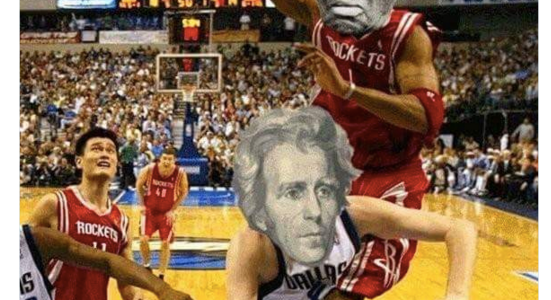
As I searched sites like Twitter, Instagram, Facebook, and Breitbart News (that is a horrid and terrifying place), I noticed three common themes emerging among the dissenters, 1)  Harriet Tubman is ugly, 2) This is just one more plan by President Obama to ruin our nation (I think the term Obamanize was actually used), and 3) Most of the people complaining don’t have the faintest clue what it is they’re actually complaining about. Take the meme on the left. I seriously cried laughing. Now, the original poster, MT News, meant this as a knock against the current social media outcry over the Tubman decision. BUT, as it has been passed about the webs it has become a representation of hatred as more and more people share it because they believe the sentiment behind the wording, rather than understand the irony behind the image.
I’ve been trying to understand this situation and in order for me to do that, I need to break down each of the themes individually and view them through personal, historical, and social media lenses.
1) “Let’s face it, that broad is FUGGGLY!”
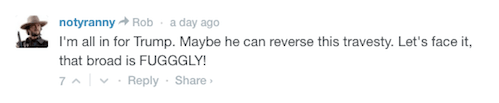
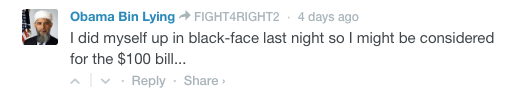

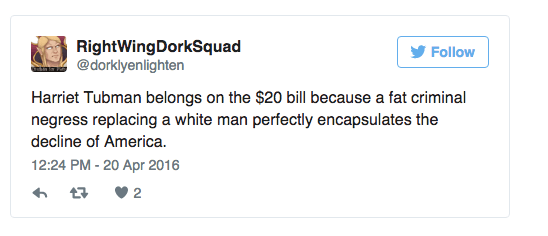
These are some of the many random comments and tweets I took screen shots of regarding the strange fascination Americans seem to have with how ugly Harriet Tubman is. I’ve lost count of the amount of times people commented on her “fat ass”, ugly face, and bad hair. The comments range from mildly annoying to downright racist. I personally don’t see the purpose of this logic. I mean, I agree, she’s not a looker, but neither am I. Hell, neither is most of the American population. Furthermore, what do looks have to do with her accomplishments or worthiness of being the face of the new twenty dollar bill? I could see this being a tad more logical if say, Ben Franklin or Abraham Lincoln were even remotely good looking, but let’s face it, our Founding Fathers and former presidents don’t often have that going for them as a trait. I have to believe deep down that America can’t be THAT superficial which means I AM choosing to believe that America IS that racist. I firmly believe these tirades are driven by ignorance, by the fact that deep down these people are pissed that a black woman is replacing a white man and while some show it more willingly than others, they have to look for seemingly less offensive ways to complain about the new face of the twenty.

2) “Obama’s Last Stab”
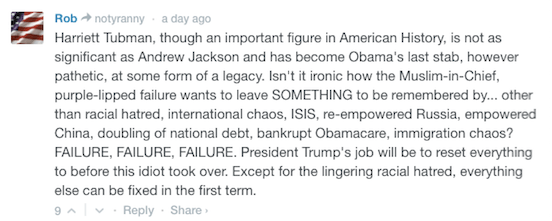

According to US law it is usually the Secretary of the Treasury (yes, I know, he WAS appointed by President Obama, but he was also APPROVED 71-26 by the US Senate…which means…that’s right…Republicans said yes too…) who determines which people and which of their portraits appear on US currency. However, legislation passed by Congress can also determine currency design. That doesn’t mean the President can’t make requests or suggestions regarding the matter, but it does mean HE CANNOT put Tubman on the twenty, regardless of whether he wants her there or not.
This most recent push for changing our currency had great help from a grassroots movement called “Women on 20s“, who gathered support for their cause and then petitioned President Obama to “instruct” Jacob Lew to put a woman on the twenty dollar bill. After a year of work, and the collection of hundreds of potential names for this honor, Jacob Lew, the Secretary of the Treasury, made the decision to honor the women’s suffrage movement on the 5, 10, and 20 dollar bills. Lew wrote a letter to the American people detailing his decision. By 2020 the plan is to have added women, white and black alike to the 5, 10, and 20 dollar bills. (By the by, 2020 marks the one hundred year anniversary of the 19th Amendment, which gave women the right vote).
3) We the People need a history lesson…
So now we’ve sort of come full circle, returning to the question that started me on this path, “why Harriet Tubman?” In my infinite wisdom, I decided that in order to understand “Why Harriet Tubman”, I had to first understand why any of them, so I started my research with the question, “why the presidents on the money?” I was curious. I learned a lot, including this, which actually surprised me.
Treasury Department records do not reveal the reason that portraits of these particular statesmen were chosen in preference to those of other persons of equal importance and prominence. By law, only the portrait of a deceased individual may appear on U.S. currency and securities. Specifics concerning this law may be found under United States Code, Title 31, Section 5114(b). (http://www.moneyfactory.gov/resources/faqs.html)
Basically, at least according to the Bureau of Engraving and Printing, part of the US Department of the Treasury, there really isn’t an answer as to why the men who grace our current bills were “lucky” enough to have their mugs picked in the first place. There IS a lot of speculation out there. Some of it from highly intelligent and respected people, and some of it is just downright entertaining, in a sad, I hope that person doesn’t procreate sort of a way.
Taking all that into consideration I think we can safely say that Presidents Washington (one dollar bill and quarter), Lincoln (five dollar bill and penny), and F. Roosevelt (dime) are sort of no-brainers. I mean you have the hero of the Revolutionary War and first president. The Great Emancipator, the man who preserved the Union and was then assassinated a mere five days after Lee surrendered. And the man who got the US through the Great Depression and who was so well-loved they elected him four times. That’s a pretty strong list of solid contenders to be the visage of our money and I’m going to give all three two thumbs up in snap as my solid seal of approval.
The lines start to become a little blurred when we consider the rest of the “currency crew” (I like that little nickname I gave them) Ben Franklin (hundred dollar bill) and Alexander Hamilton (ten dollar bill) were not presidents, which as was noted above, does seem to matter to some people. Brushing that aside though, we have two men who were Founding Father’s of the United States and ardent supporters of independence and the federal government. Ben Franklin actually used his own personal printing company in 1739 to develop methods to make counterfeiting bills more difficult. He used leaves to create raised patterns on the bills, a practice that has been modified over the years and is still in use today. Hamilton is probably best known as the man who shot and killed Aaron Burr. But he was also the first Secretary of the Treasury under George Washington and a major supporter of a national banking system. Bearing those characteristics in mind the lines regarding those two aren’t really all that blurred, so I’m also giving these guys two thumbs up and my approval as currency portraits.
Blurrier still become our lines as we move on to Ulysses S. Grant (fifty dollar bill) and Thomas Jefferson (two dollar bill and nickel). Grant was the 18th President of the US and is generally considered a war hero from the Civil War, instrumental in the Union’s success against the Confederacy. Grant was a graduate of West Point Military Academy, one of the most prestigious colleges in our nation. On the flip-side, Grant’s success as a military strategist is highly-contested and many historians and military experts argue that what won the war was not brilliant strategy so much as his willingness to expend as many lives as possible to win the war. His war of attrition against the South earned him the nickname “the butcher” in many circles. His performance at West Point was less than average and his interest in military studies was lacking. Many historians have also recorded Grant’s presidency as a failure. His economic policies led to a depression and his involvement in the Credit Mobilier Scandal further sullied his reputation and legacy. Grant’s tenure in office wasn’t all bad, he laid important groundwork in regards to civil rights and worked toward the Reconstruction of the nation. He was president during a tumultuous time in history, so while he doesn’t get an enthusiastic two thumbs up from me (and DEFINITELY no snaps) I’m not going to say he didn’t earn his place on the fifty.
Thomas Jefferson was the third President of the United States. He was also our second Vice President under John Adams and our first Secretary of State under George Washington. He penned the Declaration of Independence and is one of our greatest Founding Fathers.  While in office Jefferson organized the Louisiana Purchase, doubling the size of the US and sent Lewis and Clark on their mission to explore that new territory. He stood up against the British and signed into law an act forbidding the importation of slaves into the United States. His policies toward Native Americans were seen as more humane than most (for the time period) and he believed in a policy of assimilation for most indigenous people. He is regarded as one of the greatest presidents of our country. BUT…Jefferson was a slave owner. He participated in the buying, selling, and inheriting of slaves. He owned over 600 slaves in his lifetime and supposedly had an affair with one of his slaves, Sally Hemings, who bore his illegitimate children. In all honesty, Jefferson is one of my favorite presidents, but there is definitely room to debate his position on our current currency because of his role in slavery.
Which leads me to our final currency portrait, the current man of the hour, Andrew Jackson. The blurriest of all lines rests here with the 7th President of the United States and Battle of New Orleans, War of 1812, hero. Andrew Jackson has been one of the most debated, most controversial, most celebrated, and most loathed presidents in our history. He was an avid politician and involved in numerous highly politicized issues including the “corrupt bargain”, and the subsequent creation of the Democratic Party, the Nullification Crisis, the killing of the National Bank, and The 1830 Indian Removal Act which later led to the “Trail of Tears”. In the election of 1832 he assumed the “jackass” as his symbol (his opponents called him that) and later Thomas Nast would popularize this symbol and it would become the emblem of the Democratic Party. He was a slave owner and slave trader and a known opponent of abolition. Many have argued that Andrew Jackson was a horrible person, not worthy of a place on our currency. Many have argued that Andrew Jackson was a great politician who prevented civil war and federal bankruptcy. I argue that isn’t it possible he was both?
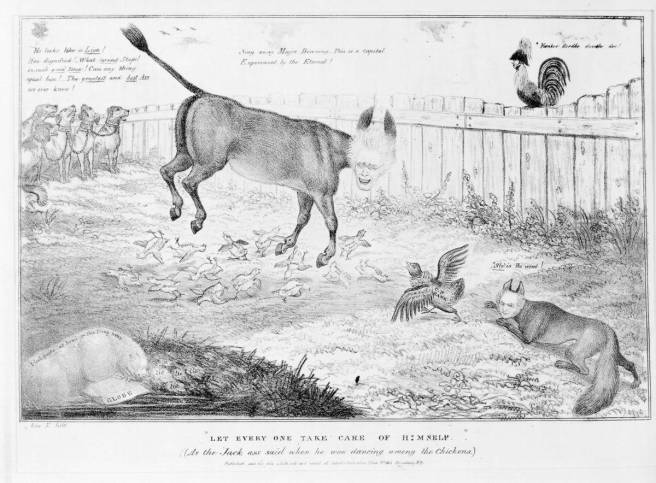
Deciding to remove Jackson from the front of the twenty dollar bill and move him to the back is not a black and white decision, although some in America are certainly trying to make it so. Removing Jackson isn’t even a knock against Jackson, but rather an attempt to move forward and recognize the pain that he caused and the pain that his legacy still causes to many in our nation. Jackson represents a time period in American history that we should be ashamed of. Jackson represents a time period in American history that we should atone for, even if it’s not directly “our fault”. The choice to replace Jackson represents a step in the direction of our government to create a more equal and more representative historical record. Jackson represents the past, and this change, well it represents progress.
Jacob Lew provided a rationale for his decision to put Harriet Tubman on the new twenty in his letter to the American people, but in case you didn’t go to the link yet, I’ll sum up in my opinion why Harriet Tubman was an excellent choice.
Harriet Tubman was a remarkable woman. She was born a slave in 1820 in Maryland, but she escaped it. She suffered a serious and debilitating head injury at the hands of a slave driver, but she overcame it. She helped over 300 people escape slavery on the Underground Railroad. She was so successful in her work that she was dubbed “Moses” by William Lloyd Garrison. She served as a spy, nurse, and a cook during the Civil War. After the war was over she created schools for black children and built a home for the elderly. She opened her door and her garden to anyone in need, regardless of race, gender, or religion. She fought for racial equality as well as gender equality and the right for woman to vote. As a symbol, Harriet Tubman is the EXACT opposite of Andrew Jackson. She represents PROGRESS. She represents HOPE. Harriet Tubman was BRAVE. She was KIND. She was INSPIRING. Harriet Tubman IS worthy of this acknowledgement. She IS worthy of this honor. She represents the America that I want to be proud of. The America we should be promoting. The America I want to be a part of and I personally am CELEBRATING this moment.
 I thought my anger reached its fullest potential following the Super Bowl. I remember so many people taking to Facebook and Twitter, blasting Beyonce, Bruno Mars, Cold Play, The NFL, CBS, even Pepsi for allowing Beyonce to perform “Formation” during the Half Time Show. The comments ranged from laughable to ignorant to downright racist and hateful. I trolled various Facebook posts and Twitter feeds and found myself experiencing a myriad of reactions and emotions. Like so many people I don’t know what to do, what to say, how to help. I can’t fathom a scenario where I can do anything to fix this, but I can also no longer stay quiet. I started this post months ago, then I put this aside and debated whether I should post it. Then Alton Sterling was shot and killed yesterday and the need to say something has once again risen up in my soul. This time I’m going to allow it a voice.
 Seriously, when a black person tells you that their lives are different from yours because you are white and they are black, that’s not a dig against you. They aren’t blaming you for it or asking you to apologize for it, they’re simply stating a point of fact. The truth is, we don’t like this fact because deep down, in places we don’t like to talk about at parties, this fact makes us feel all icky and yucky inside. It makes us feel guilty and it makes us feel bad about being white (which, as we’ve established, isn’t our fault). I mean, why should we feel bad about being white when we had no control over who our parents are and what our heritage is? IT’S NOT OUR FAULT!!! Cue the violins and listen closely. NO ONE IS SAYING IT IS. The only person making you feel guilty for being white is you. The only person making you think you’re supposed to apologize for slavery and Apartheid and Jim Crow is you. The only person making you proclaim that you are not a racist is you. Black people are NOT white shaming you. They’re just asking you to lend their point-of-view some credence. They’re asking you to stop denying racism because admitting it makes you feel uncomfortable. They’re asking you to have an open and honest conversation with them about race. They’re asking you to stop pretending that you know what it is like to be black in America because YOU DON’T.
 Diary of A Kitten Addict